August 7, 2026
Healthcare Staffing: The Complete Guide for Modern Medical Practices
.png)
Growth creates opportunity for healthcare practices, but it also creates pressure.
More patients mean more appointments to schedule, more calls to answer, more insurance to verify, more authorizations to process, more documentation to manage, and more billing activity to coordinate.
Eventually, a growing practice reaches a critical question:
How do we increase capacity without allowing overhead and administrative complexity to grow just as quickly?
For many healthcare organizations, part of the answer is remote healthcare staff.
Rather than relying exclusively on additional in house employees, practices are increasingly building teams that combine on-site clinical and patient-facing staff with remote professionals who handle administrative responsibilities behind the scenes.
Here’s why this staffing model can be particularly valuable for growing practices.
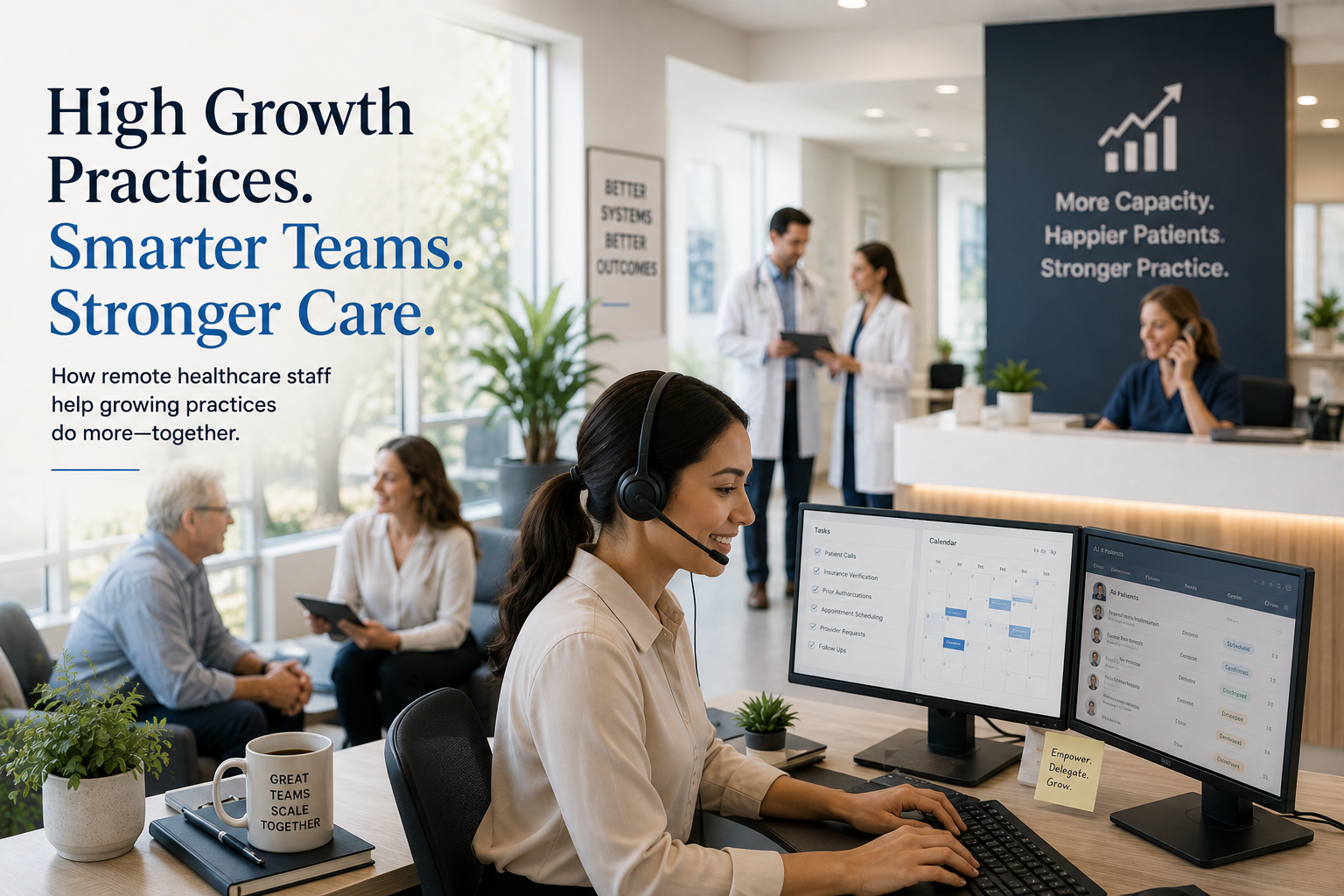
High growth healthcare practices may use remote staff to expand administrative capacity without requiring every new team member to work inside the office.
Remote healthcare professionals can support scheduling, patient communication, insurance verification, prior authorizations, billing, documentation, and other administrative workflows, helping practices build more flexible operations as patient volume increases.
When a healthcare practice grows, it’s easy to focus exclusively on patient volume.
But every additional patient creates administrative work before, during, and after the appointment.
Consider everything surrounding a typical visit:
As volume increases, these responsibilities multiply.
A practice may have enough clinical capacity to see additional patients but lack the administrative capacity required to support them efficiently.
One of the primary reasons growing practices explore remote staffing is simple: they need more hands.
Administrative responsibilities that once took a few hours each week can become full-time workloads as the organization expands.
Remote staff can provide dedicated support for specific workflows without requiring every administrative role to be performed inside the physical practice.
This can help create additional capacity while allowing existing staff to concentrate on their core responsibilities.
Not every administrative responsibility needs to happen at the front desk.
Yet in many practices, front office employees are simultaneously:
That creates constant interruption.
Delegating appropriate behind-the-scenes work to remote team members can allow on-site employees to spend more attention on the patients physically in front of them.
Traditional expansion can create physical constraints.
Additional employees may require:
Remote staffing provides another way to expand certain administrative functions without necessarily expanding the physical footprint of the practice at the same rate.
For organizations operating in expensive or limited office space, that flexibility can be particularly valuable.
Growth is rarely perfectly predictable.
A practice may add a provider, open a new location, introduce a new service line, or experience a significant increase in patient demand.
Administrative staffing needs can change quickly alongside those developments.
Remote staffing can provide another option for practices looking to build a workforce that can adapt as operational requirements evolve.
Smaller practices often rely on generalists.
One employee may answer phones, schedule appointments, verify insurance, and manage referrals.
As organizations grow, specialization can become more valuable.
A larger practice may eventually benefit from dedicated support for:
Remote staffing can make it easier to build administrative roles around specific workflows rather than expecting every employee to handle everything.
Practice growth becomes difficult when physicians and other providers remain heavily involved in routine administrative responsibilities.
A provider’s time is limited.
When that time is consumed by scheduling issues, administrative messages, paperwork, or other non-clinical responsibilities, the practice may struggle to fully utilize its clinical capacity.
Thoughtful delegation helps ensure work is performed by the appropriate member of the team.
As healthcare organizations expand geographically, administrative complexity can increase quickly.
Different locations may develop different processes, creating inconsistencies across the organization.
Certain remote administrative functions can potentially be centralized across locations.
For example, a centralized remote team might support:
Centralization can help organizations create more consistent processes as they grow.
Modern healthcare practices already operate through a growing collection of digital systems.
Teams regularly use:
Because many administrative workflows already happen digitally, certain responsibilities no longer require the employee performing them to sit inside the practice.
The important consideration is ensuring remote access is implemented in accordance with applicable privacy, security, organizational, and regulatory requirements.
Growth is valuable, but profitable growth requires attention to expenses.
The cost of an employee extends beyond wages and can include recruiting, benefits, payroll-related expenses, equipment, office space, and other overhead depending on the employment arrangement.
Remote staffing models may offer practices another way to structure administrative costs.
The appropriate model depends on the organization’s requirements, responsibilities, and staffing strategy.
The biggest advantage of remote staffing isn’t simply that someone works from another location.
It’s what the model can allow a practice to build.
A scalable healthcare organization has systems that can accommodate increasing demand without creating unnecessary operational complexity.
That typically means:
Remote staff can become one component of that larger operational structure.
Remote staffing doesn’t have to mean replacing existing employees.
In many cases, the strongest model is a combination of both.
On-site employees can focus on responsibilities that benefit from physical presence, including greeting patients, managing the office environment, and supporting face-to-face interactions.
Remote employees can focus on administrative workflows that can be performed effectively from another location.
The objective is to put each responsibility in the hands of the team member best positioned to handle it.
Depending on their experience, training, access, and assigned role, remote healthcare staff may support:
Not every responsibility is appropriate for every remote worker, so duties should be matched to the individual’s qualifications and the practice’s policies.
It may be worth exploring remote administrative support when:
The best time to build additional capacity is often before operational bottlenecks begin limiting growth.
No. Solo providers, small practices, multi-provider groups, and larger healthcare organizations may all use remote administrative support depending on their needs.
Depending on their assigned responsibilities and the practice’s procedures, remote administrative staff may assist with scheduling, reminders, routine inquiries, and other patient communication.
Remote team members may be provided appropriate system access when required for their responsibilities, subject to the practice’s access controls, privacy policies, security requirements, and applicable regulations.
Not necessarily. Many practices use remote staff to complement their existing team by moving time-consuming back-office responsibilities away from employees who need to remain focused on the physical office.
No. Remote healthcare teams can include professionals supporting scheduling, insurance verification, prior authorizations, billing, coding, documentation, administrative operations, and other specialized functions.
High growth healthcare practices face a unique challenge: increasing capacity without allowing complexity and overhead to grow uncontrollably.
Remote healthcare staffing provides one way to approach that challenge.
By combining on-site teams with experienced remote administrative professionals, practices can distribute responsibilities more strategically, create specialized workflows, and build operational capacity around increasing patient demand.
The goal isn’t simply to hire remotely.
It’s to build a healthcare organization that can grow without becoming increasingly difficult to operate.
As your practice grows, the right administrative structure can make a significant difference.
Winning Assistants helps healthcare practices build dedicated remote teams for patient communication, scheduling, insurance verification, prior authorizations, billing, documentation, and other administrative functions.
If your current team is reaching capacity, book a free consultation to discuss your practice’s needs and explore whether remote healthcare staff could support your next stage of growth.