August 7, 2026
Healthcare Staffing: The Complete Guide for Modern Medical Practices
.png)
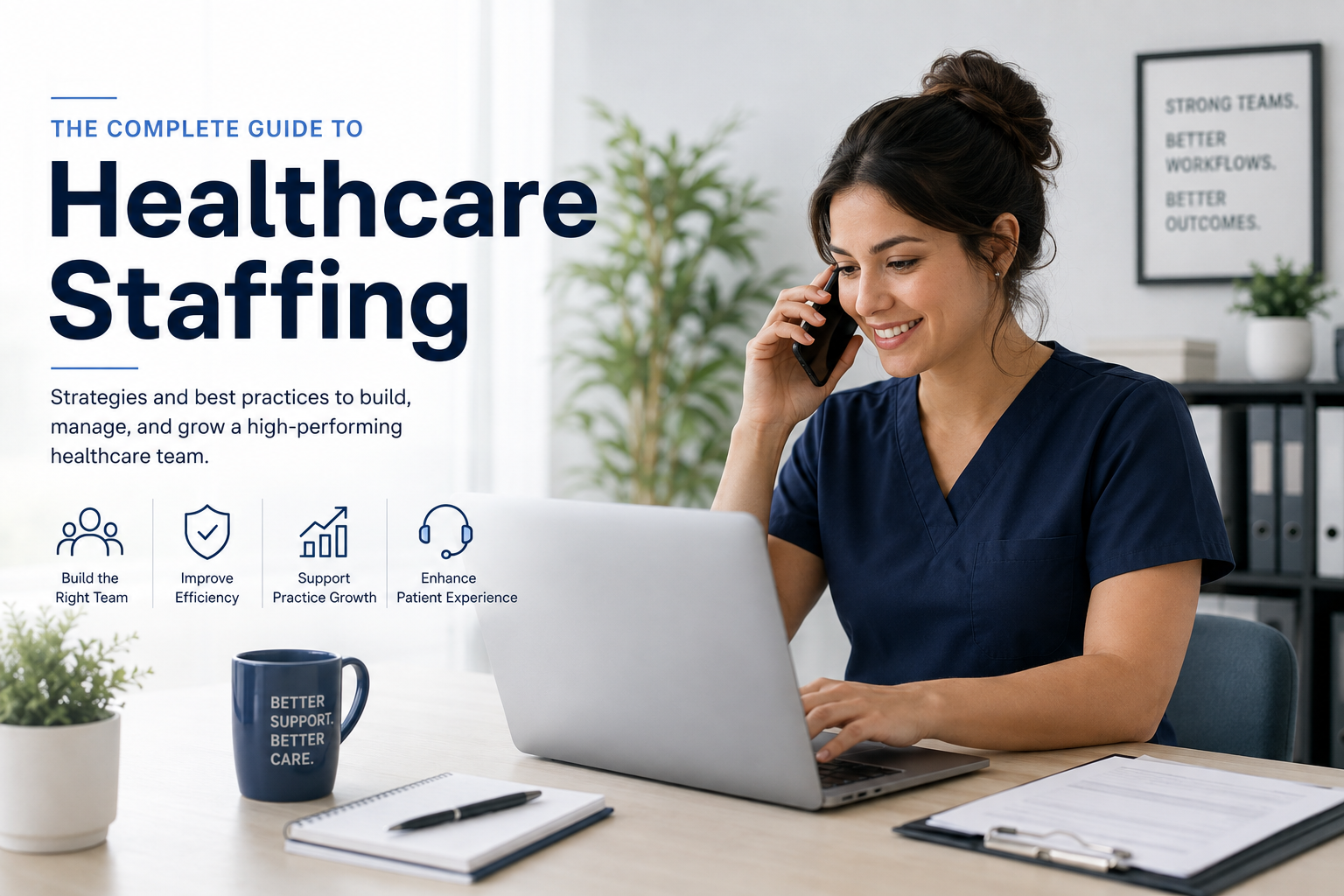
Building the right healthcare team has never been more important—or more challenging.
Healthcare organizations today face increasing administrative demands, workforce shortages, rising labor costs, and growing patient expectations. At the same time, providers are expected to deliver exceptional patient care while keeping their practices running efficiently.
Effective healthcare staffing is no longer just about filling open positions. It’s about building a team with the right people, skills, and systems to support long-term success.
This guide explores modern healthcare staffing strategies and what practice owners should consider when growing their teams.
Healthcare staffing is the process of recruiting, hiring, managing, and supporting the people who keep a healthcare practice operating. Modern staffing strategies often combine in-office employees, virtual healthcare assistants, technology, and standardized workflows to improve efficiency while supporting high-quality patient care.
Every successful healthcare practice depends on a strong team.
Providers rely on administrative staff to keep operations moving efficiently while delivering a positive patient experience.
When staffing is well planned, practices often experience:
A thoughtful staffing strategy helps create a practice that can scale without sacrificing quality.
Many healthcare organizations face similar staffing obstacles.
These may include:
Addressing these challenges often requires more than simply hiring additional employees.
Today’s healthcare practices are moving beyond traditional staffing models.
Many organizations now combine:
This blended approach allows practices to improve efficiency while remaining flexible as they grow.
Every practice has different staffing needs, but common administrative roles include:
Clearly defining responsibilities helps improve accountability and workflow efficiency.
Successful staffing begins with hiring individuals who have the right experience for the role.
Consider evaluating:
The right person can contribute far more than simply completing assigned tasks.
Even exceptional employees benefit from clear systems.
Develop documented procedures for:
Standardized workflows help new team members become productive more quickly while improving consistency.
Technology continues to reshape healthcare staffing.
Practices increasingly use:
Technology works best when paired with experienced people and clearly defined processes.
Healthcare staffing isn’t simply about solving today’s problems.
It’s about preparing for future growth.
When evaluating staffing decisions, consider:
Planning ahead helps reduce future disruption.
Healthcare staffing is the process of recruiting, hiring, managing, and supporting the professionals who help healthcare organizations deliver clinical and administrative services.
Growing patient demand, administrative complexity, workforce shortages, rising labor costs, and evolving technology have all changed how healthcare organizations approach staffing.
Many non-clinical administrative responsibilities can be performed remotely, including scheduling, patient communication, insurance verification, prior authorizations, medical billing support, documentation, medical scribing, referral coordination, and other administrative workflows.
Clear workflows, standardized procedures, strategic delegation, modern technology, and building the right mix of in-office and remote administrative support can all improve operational efficiency.
Healthcare staffing is evolving rapidly.
Practices that invest in strong administrative systems, thoughtful hiring strategies, and efficient workflows are often better positioned to improve operations while delivering exceptional patient experiences.
Rather than simply adding more employees, many successful healthcare organizations are building flexible teams that combine experienced people, modern technology, and standardized processes to support long-term growth.
At Winning Assistants, we help healthcare practices build high-performing administrative teams by providing experienced virtual healthcare assistants who support scheduling, patient communication, insurance verification, prior authorizations, medical billing support, documentation, medical scribing, referral coordination, and many other non-clinical healthcare workflows.
If you’re looking to strengthen your healthcare team while improving operational efficiency, book a free consultation to learn how a virtual healthcare assistant can support your practice.