

August 7, 2026
Healthcare Staffing: The Complete Guide for Modern Medical Practices
.png)
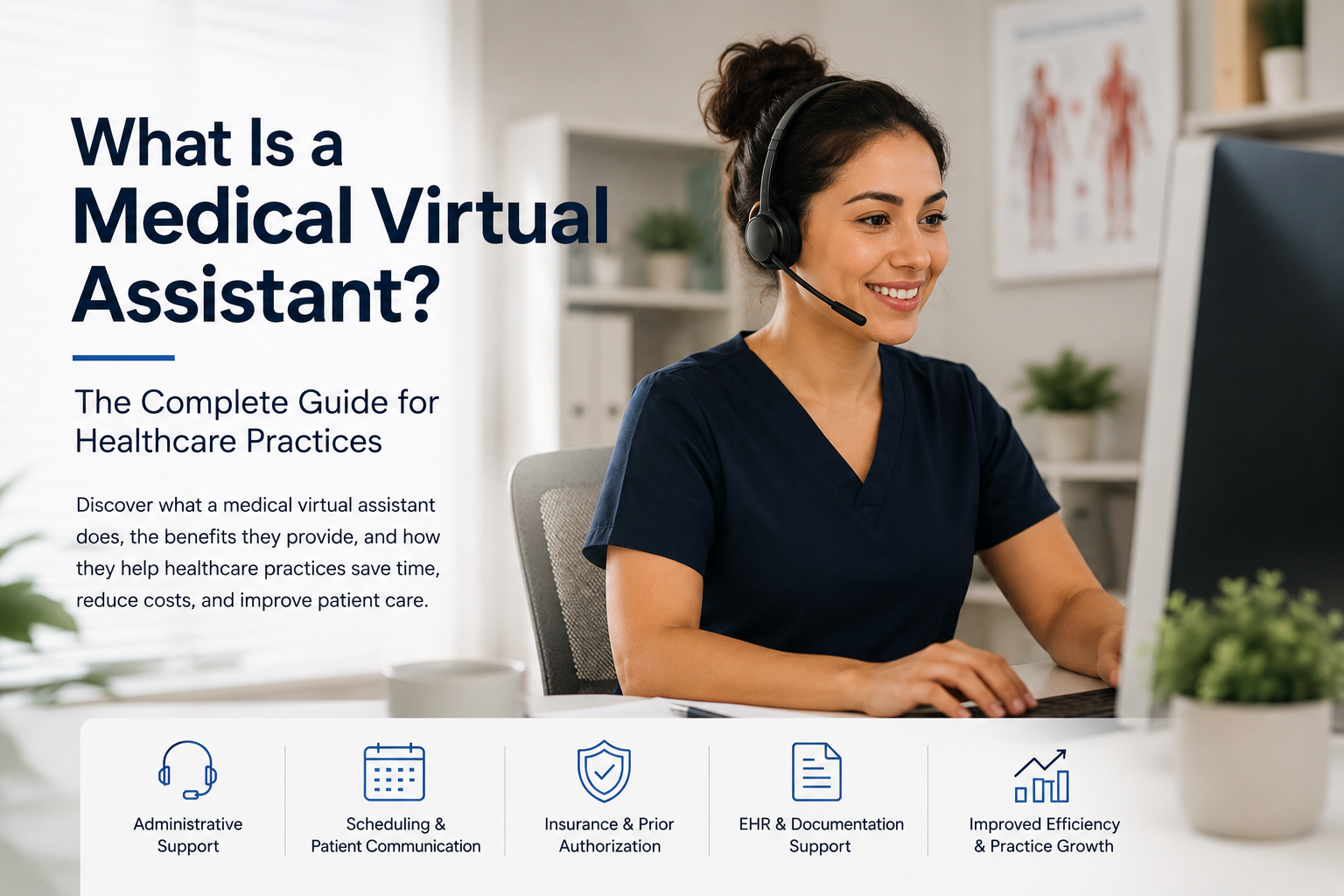
Healthcare practices today face growing operational challenges. Staffing shortages, rising payroll costs, increasing administrative responsibilities, and provider burnout have made it more difficult than ever to operate efficiently while maintaining exceptional patient care.
As a result, many healthcare organizations are rethinking how they build their teams.
One solution that has become increasingly popular is the medical virtual assistant.
Medical virtual assistants can help healthcare practices manage many of the administrative responsibilities that keep an office running smoothly. From answering phones and scheduling appointments to insurance verification, patient communication, documentation support, and medical billing assistance, they allow providers and in-office staff to spend more time focused on patient care rather than paperwork.
If you’re considering hiring one for your practice, this guide explains what a medical virtual assistant is, what they do, how they differ from traditional employees, and how they can support a more efficient healthcare operation.
A medical virtual assistant is a remote administrative professional who supports healthcare providers by handling non-clinical responsibilities such as appointment scheduling, patient communication, insurance verification, prior authorizations, electronic health record (EHR) updates, medical billing support, and other day-to-day administrative tasks.
Unlike general virtual assistants, medical virtual assistants are familiar with healthcare workflows, medical terminology, and the operational needs of healthcare practices.
The responsibilities of a medical virtual assistant vary depending on the type of practice, specialty, and operational needs.
Some healthcare organizations hire virtual assistants primarily for front office support, while others rely on them to assist with documentation, patient communication, insurance-related tasks, or revenue cycle management.
Common responsibilities include:
Because every healthcare practice operates differently, responsibilities can be tailored to fit each organization’s workflow and staffing needs.
Healthcare providers continue to face increasing pressure to improve efficiency while controlling operating costs.
Administrative work continues to grow.
Hiring experienced office staff has become increasingly competitive.
Providers are expected to document more, communicate more, and manage more without sacrificing patient care.
Medical virtual assistants can help address these challenges by providing dedicated administrative support without requiring additional office space or many of the expenses associated with traditional in-house employees.
For many practices, they represent a practical way to expand administrative capacity while maintaining operational efficiency.
Although both roles provide remote administrative support, there are important differences.
A general virtual assistant may have experience supporting businesses across multiple industries, but healthcare practices have unique operational requirements.
Medical virtual assistants often understand:
This healthcare-specific knowledge can help them integrate into medical practices more efficiently while requiring less industry-specific training.
Administrative responsibilities can consume hours of a provider’s day.
Delegating repetitive operational tasks allows physicians and office staff to focus more of their time on patient care rather than paperwork.
Timely communication is an important part of the patient experience.
Medical virtual assistants can help ensure calls are answered promptly, appointments are scheduled efficiently, reminders are sent, and patient questions receive timely responses.
Hiring remote administrative professionals can often reduce expenses associated with office space, equipment, recruiting, employee benefits, and other overhead costs while still providing dedicated administrative support.
When administrative bottlenecks are reduced, practices are often able to serve more patients without proportionally increasing overhead.
This allows providers to spend more time practicing medicine instead of managing day-to-day administrative work.
As patient volume increases, administrative responsibilities naturally grow as well.
Medical virtual assistants provide scalable support that allows healthcare organizations to expand administrative capacity more efficiently.
Medical virtual assistants support practices across nearly every healthcare specialty.
Common examples include:
Regardless of specialty, nearly every healthcare organization has administrative processes that can be delegated to experienced remote professionals.
Medical virtual assistants are designed to support healthcare providers, not replace licensed clinical staff.
Responsibilities that generally remain with licensed providers or on-site personnel include:
Medical virtual assistants do not diagnose conditions, prescribe medications, or make clinical decisions unless they hold appropriate professional credentials and are authorized by applicable laws and the hiring practice.
Instead, they support the administrative functions that allow clinical teams to focus on delivering patient care.
Security is one of the most common questions healthcare providers ask.
When appropriate safeguards are in place, remote administrative support can operate securely while helping protect patient information.
Healthcare-focused staffing partners may provide professionals who are familiar with healthcare environments, HIPAA considerations, and remote operational best practices. However, healthcare organizations remain responsible for implementing their own privacy, security, and compliance policies in accordance with applicable laws and regulations.
Practices should also ensure remote team members receive appropriate training, follow established security procedures, and use secure systems when accessing sensitive information.
The cost of hiring a medical virtual assistant depends on several factors, including experience, responsibilities, schedule, and the hiring model you choose.
Some practices hire independently, while others partner with specialized healthcare staffing companies that recruit, vet, onboard, and support dedicated professionals.
Although pricing varies, many healthcare practices find that remote administrative staffing can offer meaningful cost savings compared to hiring additional full-time in-house administrative employees.
Your practice may benefit from a medical virtual assistant if you are experiencing:
These are common indicators that additional administrative support may improve efficiency while allowing your team to focus on patient care.
Yes. Many medical virtual assistants manage inbound calls, schedule appointments, answer routine questions, and assist with patient communication according to your practice’s procedures.
Yes. With the appropriate training, access permissions, and organizational policies in place, many medical virtual assistants assist with chart preparation, documentation, patient records, and electronic health record updates.
Yes. Insurance verification, benefits verification, referral coordination, and prior authorization support are among the most commonly delegated administrative responsibilities.
Many healthcare-focused staffing companies require HIPAA training before placing virtual assistants with clients. Practices should verify training, compliance standards, and internal policies during the hiring process.
Absolutely. Solo practitioners and smaller healthcare offices often use medical virtual assistants to expand administrative capacity without the expense of hiring additional full-time in-office staff.
Healthcare continues to evolve, and successful practices are finding new ways to improve efficiency while maintaining exceptional patient care.
Medical virtual assistants have become an increasingly valuable solution for providers looking to reduce administrative burdens, improve patient communication, and create more time for the work that matters most.
Whether you’re a solo provider or a growing multi-location practice, the right medical virtual assistant can become a seamless extension of your administrative team, helping your organization operate more efficiently while supporting sustainable long-term growth.
At Winning Assistants, we help healthcare practices connect with experienced medical virtual assistants who become a seamless extension of their administrative team. Whether you need support with scheduling, insurance verification, patient communication, billing support, documentation, or other administrative responsibilities, we can help you find the right fit for your practice.
Schedule a Free Consultation to learn how a dedicated medical virtual assistant can help your practice save time, improve operational efficiency, and allow your providers to focus more on delivering exceptional patient care.