
August 7, 2026
Healthcare Staffing: The Complete Guide for Modern Medical Practices
.png)
Healthcare is changing rapidly.
Rising administrative demands, staffing shortages, increasing operating costs, and growing patient expectations have led many healthcare practices to rethink how they build and support their teams.
One solution that continues to gain traction is the medical virtual assistant.
Medical virtual assistants provide remote administrative support that helps healthcare organizations improve efficiency while allowing providers and in-office staff to spend more time focused on patient care.
Whether you’re hearing about medical virtual assistants for the first time or actively considering adding one to your team, this guide covers everything you need to know.
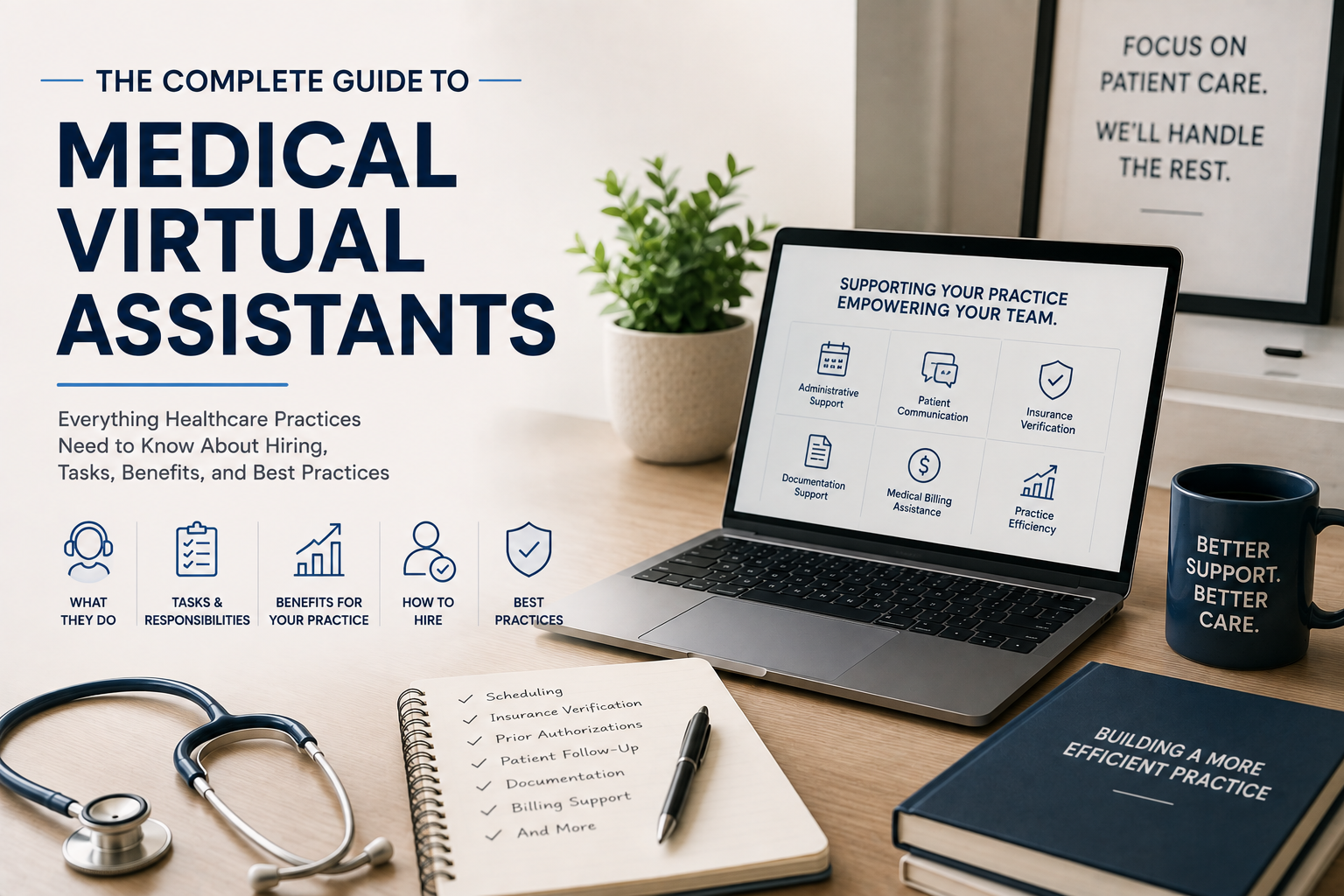
A medical virtual assistant is a remote administrative professional who supports healthcare practices by handling non-clinical responsibilities such as appointment scheduling, patient communication, insurance verification, prior authorizations, documentation support, electronic health record management, and medical billing assistance.
Rather than replacing clinical staff, medical virtual assistants help practices operate more efficiently by taking ownership of time-consuming administrative work.
A medical virtual assistant is a dedicated remote professional who performs administrative responsibilities for healthcare providers and medical practices.
Unlike a general virtual assistant, a medical virtual assistant typically understands healthcare workflows, medical terminology, patient communication, and administrative processes unique to healthcare organizations.
Depending on the practice, they may work alongside physicians, nurse practitioners, physician assistants, office managers, front desk teams, and billing departments.
The responsibilities assigned to a medical virtual assistant depend on the needs of each healthcare practice.
Common responsibilities include:
Every practice has different workflows, so responsibilities should be customized accordingly.
Medical virtual assistants support healthcare providers across a wide variety of specialties.
Examples include:
Although workflows vary between specialties, nearly every practice has administrative responsibilities that can be delegated remotely.
Healthcare practices often choose to hire medical virtual assistants for several reasons.
Administrative work can consume a significant portion of a provider’s day.
Delegating routine operational responsibilities allows physicians and staff to focus more on patient care.
Medical virtual assistants can help practices maintain timely communication through appointment scheduling, reminders, follow-up calls, and patient inquiries.
As patient volume increases, administrative work grows alongside it.
Medical virtual assistants provide additional support that allows practices to expand administrative capacity without immediately increasing office space.
When repetitive administrative responsibilities are delegated appropriately, providers and office staff often have greater capacity to focus on higher-value work.
Many growing healthcare organizations use remote administrative professionals as part of a long-term staffing strategy because they offer flexibility as operational needs evolve.
Medical virtual assistants commonly assist with:
The right responsibilities depend on your team’s workflow and staffing goals.
Hiring successfully starts with understanding your practice’s needs.
A typical hiring process includes:
Taking time to prepare before hiring often leads to a smoother onboarding experience.
Pricing varies depending on several factors, including:
Some practices hire independently, while others work with staffing companies that provide recruiting, screening, onboarding, payroll administration, and ongoing support.
Practices should evaluate overall value rather than comparing hourly rates alone.
Many healthcare providers consider hiring a medical virtual assistant when they begin experiencing challenges such as:
Recognizing these challenges early often allows practices to expand support before operational issues become more significant.
Medical virtual assistants complement healthcare teams by handling administrative responsibilities.
Responsibilities that generally remain with licensed providers or on-site staff include:
This division allows each team member to focus on the work they are best equipped to perform.
Yes. Many medical virtual assistants manage incoming calls, schedule appointments, answer routine patient questions, and route messages according to the practice’s procedures.
Yes. Insurance verification, benefits verification, and prior authorization support are among the most commonly delegated administrative responsibilities.
With the appropriate permissions and organizational policies, many medical virtual assistants assist with chart preparation, documentation, and electronic health record updates.
Absolutely.
Many independent providers use medical virtual assistants to expand administrative capacity while keeping overhead manageable.
Not necessarily.
Many healthcare practices use both remote and on-site administrative staff together, allowing each team member to focus on the responsibilities best suited to their role.
Medical virtual assistants have become an increasingly valuable part of modern healthcare operations.
By helping manage scheduling, patient communication, insurance verification, documentation, billing support, and other administrative responsibilities, they allow healthcare providers to spend more time focused on delivering exceptional patient care.
Every practice is different, but the right administrative support can help improve efficiency, strengthen workflows, and create a more scalable foundation for future growth.
Every healthcare practice has unique operational needs.
If you’re exploring whether a medical virtual assistant could help your organization improve efficiency and reduce administrative burden, book a free consultation with Winning Assistants.
We’ll learn about your practice, discuss your goals, and help you determine the right administrative support solution for your team.