August 7, 2026
Healthcare Staffing: The Complete Guide for Modern Medical Practices
.png)
As healthcare practices grow, one of the biggest decisions providers face is how to build the right administrative team.
Should you hire another in house employee, or would a medical virtual assistant better support your practice?
The answer depends on your workflow, staffing needs, budget, and long-term goals.
Both options provide valuable support, but they serve different purposes. An in house employee is essential for responsibilities that require a physical presence, while a medical virtual assistant can often handle many administrative functions remotely, allowing providers and office staff to focus more on patient care.
This guide compares both staffing models so you can determine which solution is the best fit for your practice.
A medical virtual assistant is often a strong solution for healthcare practices looking to delegate administrative responsibilities such as appointment scheduling, patient communication, insurance verification, prior authorizations, documentation support, and medical billing.
An in house employee is typically the better choice for responsibilities that require physical interaction with patients or an on-site presence.
Many successful healthcare practices combine both models to create a more efficient and scalable administrative team.
Before comparing the two, it’s important to understand what each role typically involves.
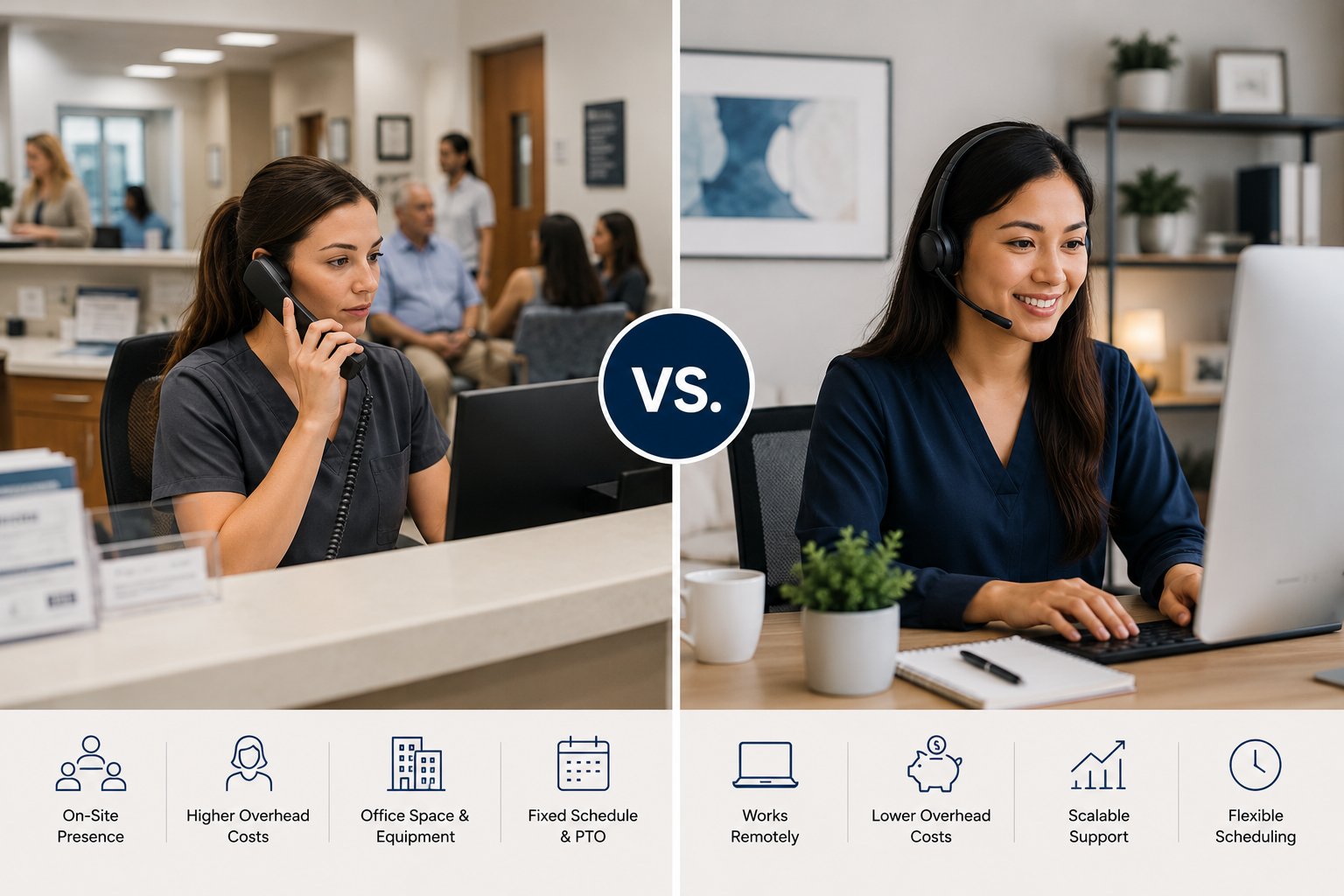
A medical virtual assistant works remotely and focuses primarily on administrative support.
An in house employee works on-site and may perform both administrative and patient-facing responsibilities throughout the day.
Rather than competing against one another, these roles often complement each other.
Medical virtual assistants commonly assist with responsibilities such as:
Because they work remotely, medical virtual assistants are often able to focus exclusively on administrative workflows that keep a practice operating efficiently.
An in house employee is generally responsible for work that requires being physically present in the office.
Responsibilities may include:
These responsibilities require an on-site presence and cannot typically be performed remotely.
One of the biggest differences between the two staffing models is the overall cost of employment.
Hiring an in house employee often involves expenses beyond wages, including:
A medical virtual assistant may allow practices to reduce some of these expenses because administrative support is provided remotely.
The overall cost depends on the hiring model, responsibilities, and level of support required.
Medical virtual assistants can provide flexibility as practices grow.
Depending on the arrangement, practices may increase hours, expand responsibilities, or build larger remote teams without significantly increasing office space or administrative overhead.
Adding additional in house employees often requires more physical workspace, equipment, and onboarding.
Administrative interruptions can reduce productivity throughout the day.
Many healthcare practices choose to divide responsibilities between remote and on-site staff.
Medical virtual assistants focus on administrative workflows while in house employees concentrate on patient-facing responsibilities.
This division of work can create a more efficient daily operation.
Patients care about responsiveness, organization, and communication.
Whether administrative support comes from an in house employee or a medical virtual assistant, consistency is often more important than where the work is performed.
Many practices use medical virtual assistants to help answer calls, confirm appointments, verify insurance, and follow up with patients while in house staff continue managing the patient experience inside the office.
As healthcare practices grow, administrative work usually grows with them.
Medical virtual assistants can provide additional support without immediately requiring larger office space or additional in-person staff.
This flexibility often makes remote staffing attractive for practices planning to expand.
A medical virtual assistant may be a good fit if your practice is looking for help with:
These responsibilities can often be completed remotely while maintaining close communication with your team.
An in house employee may be the better option when responsibilities require someone to be physically present.
Examples include:
These responsibilities typically require an on-site team member.
The decision is not always one or the other.
Many growing healthcare practices combine both staffing models.
For example, an in house receptionist may greet patients and manage the front desk while a medical virtual assistant handles appointment scheduling, insurance verification, prior authorizations, patient follow up, documentation, and billing support remotely.
This approach allows each team member to focus on the responsibilities they are best equipped to perform.
Before deciding which staffing model is right for your practice, consider the following questions:
Answering these questions can help identify the staffing solution that best supports your operational goals.
It can be, depending on the hiring model, responsibilities, and total employment costs. Practices should evaluate overall cost rather than hourly rate alone.
Not entirely. Responsibilities requiring physical interaction with patients generally remain with on-site employees.
Yes. Many experienced medical virtual assistants provide billing support, insurance verification, documentation assistance, and other administrative healthcare services.
When appropriate privacy, security, and organizational policies are followed, remote administrative support can be integrated into healthcare operations responsibly.
Many healthcare organizations find that combining in house employees with medical virtual assistants creates a balanced staffing model that supports both patient care and administrative efficiency.
Choosing between a medical virtual assistant and an in house employee is not about deciding which option is universally better.
It’s about understanding the strengths of each role and determining which staffing model best supports your practice.
For many healthcare organizations, the most effective solution is a combination of both. Patient-facing responsibilities remain inside the office, while administrative work is delegated to experienced remote professionals who help keep operations running smoothly.
As your practice grows, building the right mix of on-site and remote support can improve efficiency, reduce administrative burden, and allow your team to focus more on delivering exceptional patient care.
At Winning Assistants, we help healthcare practices connect with experienced medical virtual assistants who become a seamless extension of their administrative team. Whether you need support with scheduling, insurance verification, patient communication, documentation, medical billing, or other administrative responsibilities, we can help you find the right fit for your practice.
Explore the roles we help fill, review our pricing, see how other healthcare practices have benefited through our client success stories, or book a free consultation to discuss the best staffing solution for your organization.