
August 7, 2026
Healthcare Staffing: The Complete Guide for Modern Medical Practices
.png)
Healthcare practices are under constant pressure to improve efficiency while allowing providers to spend more time with patients.
Two roles that have become increasingly common are medical scribes and medical virtual assistants.
Although these positions can overlap in certain areas, they serve different purposes within a healthcare practice.
Understanding the difference can help practice owners determine which role—or combination of roles—best supports their operational goals.
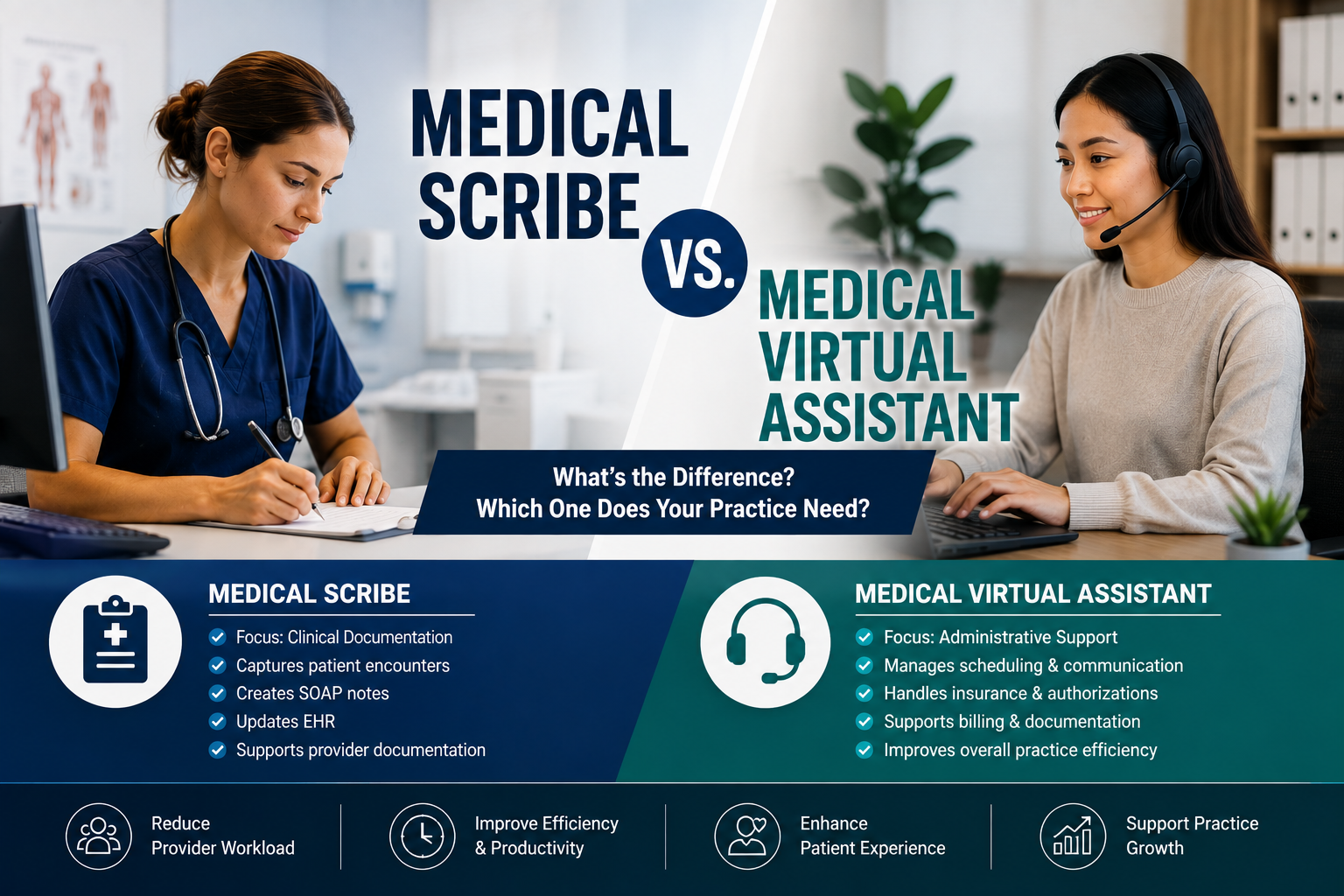
A medical scribe primarily assists with clinical documentation by recording patient encounters and preparing medical notes.
A virtual healthcare assistant provides broader administrative support that may include scheduling, patient communication, insurance verification, prior authorizations, medical billing support, documentation assistance, referral coordination, and many other non-clinical responsibilities.
Some virtual healthcare assistants also perform medical scribing duties, depending on their training and assigned responsibilities.
A medical scribe focuses primarily on documentation.
During or after a patient encounter, the scribe prepares accurate clinical documentation so the provider can spend less time completing notes.
Responsibilities may include:
The primary objective is to reduce documentation time for providers.
A virtual healthcare assistant is a remote administrative team member who supports many aspects of a healthcare practice’s daily operations.
Depending on the practice, responsibilities may include:
Rather than focusing on a single responsibility, virtual healthcare assistants often provide comprehensive operational support.
The easiest way to think about it is this:
A medical scribe is typically responsible for one specialized function—clinical documentation.
A virtual healthcare assistant supports multiple administrative workflows across the practice.
In many organizations, documentation is simply one responsibility among many.
That depends on your biggest operational challenge.
If providers are primarily struggling with documentation, a dedicated medical scribe may be an excellent solution.
If your team is overwhelmed by scheduling, insurance verification, prior authorizations, patient communication, billing support, referrals, and documentation, a virtual healthcare assistant may provide broader value.
Many growing practices begin with one responsibility and gradually expand the assistant’s role as operational needs evolve.
Yes.
Many virtual healthcare assistants have experience supporting clinical documentation in addition to administrative responsibilities.
For example, one assistant may:
This flexibility allows practices to build a role around their specific workflow rather than hiring multiple people for separate administrative responsibilities.
A dedicated medical scribe may help practices:
A virtual healthcare assistant can help practices:
For many practices, the broader scope of responsibilities makes this role a valuable long-term operational resource.
Not exactly.
Medical scribes specialize in documentation, while virtual healthcare assistants typically support a much wider range of administrative responsibilities.
Many healthcare organizations use both.
A dedicated scribe may support documentation while virtual healthcare assistants manage scheduling, insurance verification, patient communication, billing support, and other administrative workflows.
Not at all.
Depending on their training and assigned role, they may support dozens of operational processes throughout a healthcare practice.
Yes. Many virtual healthcare assistants assist with documentation, SOAP notes, and EHR updates in addition to broader administrative responsibilities.
A virtual healthcare assistant generally supports a wider variety of administrative workflows, making the role more flexible for many practices.
Not necessarily.
Some practices benefit from a dedicated scribe, while others prefer a virtual healthcare assistant who supports documentation alongside scheduling, insurance verification, patient communication, and other administrative tasks.
Every practice is different, but organizations looking to improve multiple operational workflows often find greater flexibility in a virtual healthcare assistant who can support a variety of non-clinical responsibilities.
Medical scribes and virtual healthcare assistants both play valuable roles in modern healthcare practices.
The difference comes down to scope.
A medical scribe specializes in documentation, while a virtual healthcare assistant provides broader administrative support that can improve efficiency across multiple areas of the practice.
Choosing the right solution depends on your team’s biggest operational challenges and where additional support will have the greatest impact.
At Winning Assistants, we help healthcare practices build high-performing remote administrative teams by providing experienced virtual healthcare assistants who support scheduling, patient communication, insurance verification, prior authorizations, medical billing support, documentation, medical scribing, referral coordination, and many other non-clinical healthcare workflows.
If you’re exploring ways to improve efficiency while giving providers more time to focus on patients, book a free consultation to learn how a virtual healthcare assistant can support your practice.