August 7, 2026
Healthcare Staffing: The Complete Guide for Modern Medical Practices
.png)
As healthcare practices continue exploring remote staffing solutions, one question comes up more than almost any other:
“Is it actually safe to hire an offshore virtual healthcare assistant?”
It’s a fair question.
Healthcare organizations handle sensitive patient information every day, and protecting that information is both an ethical responsibility and a legal obligation.
The reality is that safety isn’t determined by where someone works.
It’s determined by the systems, safeguards, training, and oversight surrounding their work.
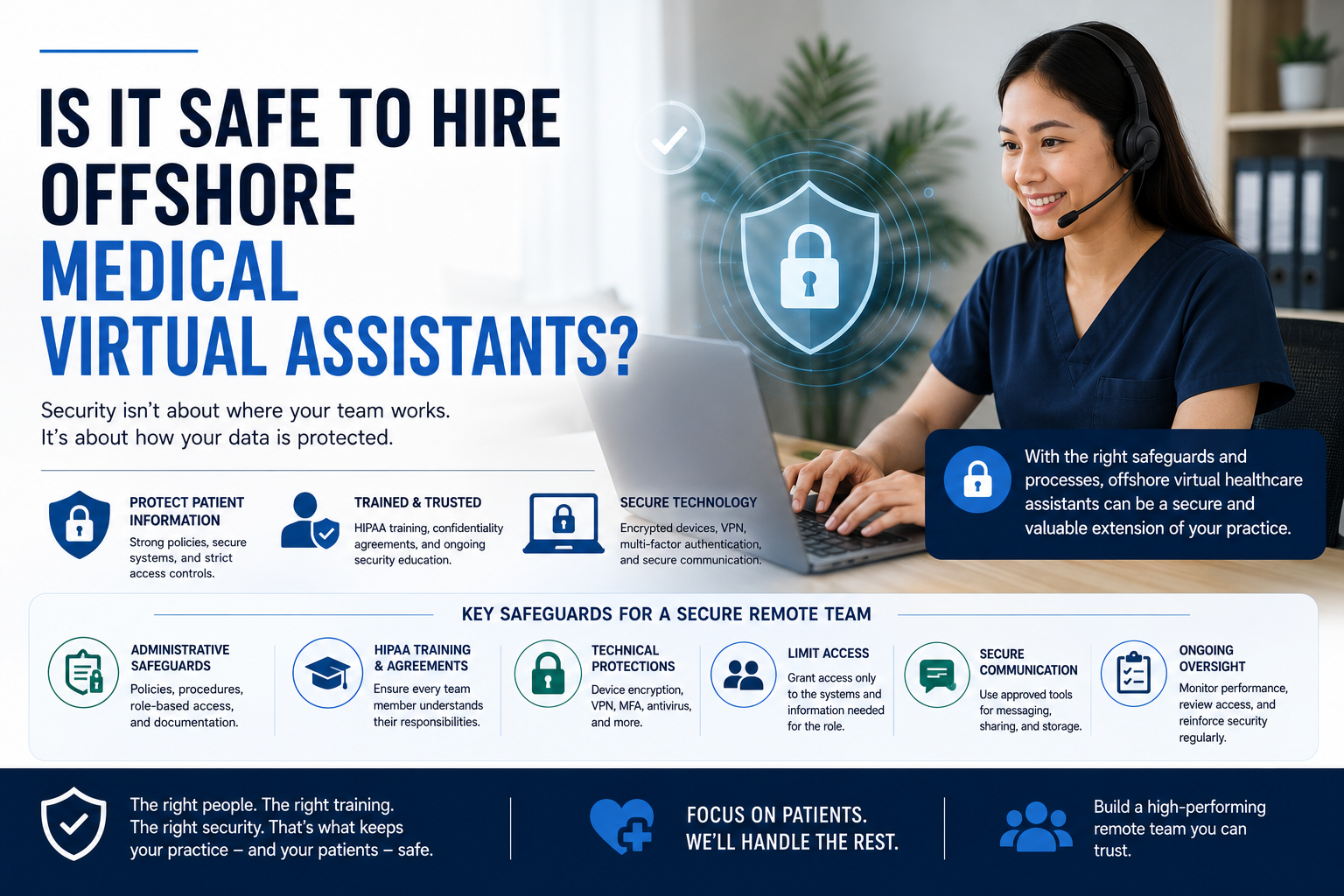
When appropriate administrative, technical, and organizational safeguards are in place, offshore virtual healthcare assistants can become a secure and valuable extension of a healthcare practice.
Yes—offshore virtual healthcare assistants can work securely with healthcare practices when appropriate safeguards are implemented. This may include HIPAA training, access controls, secure technology, encrypted devices, confidentiality agreements, documented policies, ongoing oversight, and compliance with applicable privacy and security requirements.
One of the biggest misconceptions is that working remotely automatically creates greater security risk.
In reality, security depends on how patient information is protected.
A poorly managed employee sitting inside an office may present greater risk than a well-trained remote team member working within a secure environment.
Strong security comes from consistent processes—not physical location.
Healthcare practices should establish clear administrative policies before providing access to patient information.
Examples include:
Everyone who accesses protected health information should understand their responsibilities.
Technology plays an important role in protecting sensitive information.
Depending on the organization’s environment, safeguards may include:
The specific safeguards appropriate for a practice depend on its technology and security program.
Not every team member requires access to every system.
Many practices follow the principle of least privilege, meaning employees receive access only to the systems and information required for their responsibilities.
Limiting access helps reduce unnecessary risk.
Patient information should only be shared through approved communication channels.
Healthcare practices commonly establish policies regarding:
Using secure platforms helps maintain consistency across the organization.
Healthcare administration differs significantly from general administrative work.
Practices often look for virtual healthcare assistants who already understand healthcare workflows such as:
Experience can reduce onboarding time and support more consistent operations.
If you’re considering an offshore staffing partner, ask questions such as:
A reputable provider should be able to explain its processes clearly.
Not necessarily.
Security depends on policies, technology, training, and oversight—not geography.
Remote administrative teams can operate securely when appropriate safeguards are implemented and access is managed properly.
Many healthcare organizations successfully operate with distributed administrative teams that follow the same privacy and security expectations as their in-office staff.
When evaluating a provider, consider whether they offer:
These factors often indicate a more mature operational process.
Yes, if a healthcare practice chooses to provide access and appropriate safeguards, permissions, and security controls are in place.
No. Security depends on how systems are configured, how access is managed, and whether appropriate administrative and technical safeguards are implemented.
Depending on their role, they may assist with scheduling, patient communication, insurance verification, prior authorizations, medical billing support, documentation, referral coordination, medical scribing, and many other non-clinical administrative workflows.
Ask about security practices, HIPAA training, access controls, confidentiality agreements, supervision, onboarding, and the organization’s overall approach to protecting sensitive information.
Hiring an offshore virtual healthcare assistant doesn’t have to mean compromising security.
Like any staffing decision, success depends on choosing the right people, implementing appropriate safeguards, and building clear operational processes.
When healthcare practices prioritize training, secure technology, documented procedures, and ongoing oversight, remote administrative teams can become a trusted extension of the practice while supporting efficiency and patient service.
At Winning Assistants, we help healthcare practices build high-performing remote administrative teams by providing experienced virtual healthcare assistants who support scheduling, patient communication, insurance verification, prior authorizations, medical billing support, documentation, medical scribing, and many other non-clinical healthcare workflows.
Our team members receive healthcare-specific training, and we encourage practices to implement appropriate privacy, security, and access controls that align with their organizational policies and regulatory responsibilities.
Book a free consultation to learn how a virtual healthcare assistant can support your practice while maintaining a strong focus on security and operational excellence.