

August 7, 2026
Healthcare Staffing: The Complete Guide for Modern Medical Practices
.png)
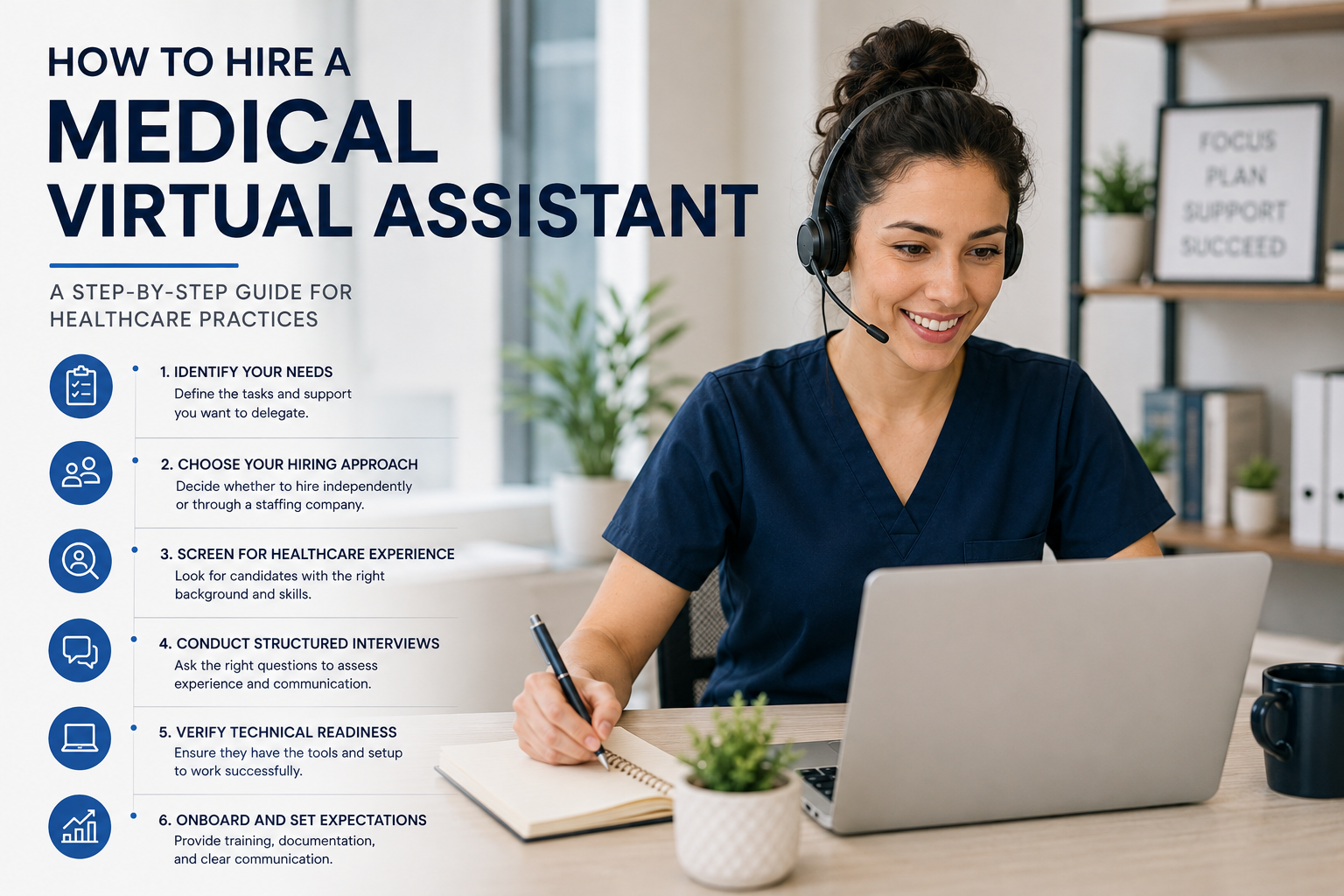
Hiring a medical virtual assistant can be one of the most effective ways to reduce administrative workload, improve operational efficiency, and give your healthcare team more time to focus on patient care.
However, finding the right person involves more than reviewing resumes or comparing hourly rates.
The most successful hiring decisions begin with understanding your practice’s needs, identifying the right responsibilities to delegate, and choosing a hiring approach that aligns with your goals.
Whether you’re hiring your first medical virtual assistant or expanding an existing remote team, this guide walks through the process step by step.
To hire a medical virtual assistant, start by identifying the administrative responsibilities you want to delegate, define the qualifications you’re looking for, choose whether to hire independently or through a staffing provider, interview qualified candidates, and create a structured onboarding process with clear expectations and communication.
Before beginning your search, determine which responsibilities are taking up the most time in your practice.
Many providers discover they spend hours each week on administrative work that could be handled by dedicated support.
Common responsibilities include:
Creating a clear list of responsibilities will help you hire someone whose experience matches your practice’s needs.
Healthcare practices generally choose one of two hiring approaches.
Hiring directly gives your practice complete control over recruiting and management.
However, you’ll typically be responsible for:
Many healthcare practices prefer working with a staffing company because much of the recruiting process is already handled.
Depending on the provider, this may include:
The right approach depends on your available time, internal resources, and hiring preferences.
Not every virtual assistant has experience working in healthcare.
When evaluating candidates, look for familiarity with responsibilities such as:
Relevant healthcare experience often reduces onboarding time and helps assistants contribute more quickly.
Communication is one of the most important qualities to evaluate.
Your medical virtual assistant may regularly interact with patients, insurance companies, and your internal team.
Look for someone who demonstrates:
Excellent communication is often just as important as technical knowledge.
During interviews, focus on real-world scenarios rather than memorized answers.
Questions you might ask include:
Behavioral questions often provide better insight than simple yes-or-no questions.
Since medical virtual assistants work remotely, they should have a reliable workspace and be comfortable using modern technology.
Consider evaluating:
Technical readiness can significantly impact onboarding and productivity.
Hiring is only the beginning.
A well-organized onboarding process often leads to better long-term success.
Your onboarding plan may include:
Clear expectations help both your team and your new assistant succeed.
Many healthcare practices make avoidable mistakes during the hiring process.
Some of the most common include:
Avoiding these mistakes can make the transition much smoother.
Before choosing a candidate, consider asking yourself:
The goal is not simply to hire quickly, but to hire thoughtfully.
Strong candidates often demonstrate:
These qualities frequently contribute to long-term success.
Healthcare experience is often preferred because it can reduce training time and improve familiarity with common administrative workflows.
Both options have advantages. Hiring independently offers greater control, while staffing companies may simplify recruiting, onboarding, payroll, and ongoing support.
The timeline varies depending on the complexity of the role, the practice’s workflows, and the assistant’s previous experience.
Many practices begin with scheduling, patient communication, insurance verification, documentation support, and administrative follow up before expanding responsibilities.
Depending on workload, schedule, and responsibilities, a medical virtual assistant may be able to support more than one provider.
Hiring a medical virtual assistant is not simply about filling a position.
It’s about creating more capacity for your practice, improving operational efficiency, and allowing your clinical team to spend more time focused on patient care.
By clearly defining your needs, hiring thoughtfully, and investing in a structured onboarding process, you can build a productive remote administrative partnership that supports your practice’s long-term success.
Finding the right medical virtual assistant doesn’t have to be complicated.
At Winning Assistants, we help healthcare practices connect with experienced remote administrative professionals who can support scheduling, insurance verification, patient communication, documentation, billing support, and many other essential responsibilities.
If you’re ready to explore whether a medical virtual assistant is the right fit for your practice, book a free consultation to discuss your goals and learn how we can help you build the right administrative team.