

August 7, 2026
Healthcare Staffing: The Complete Guide for Modern Medical Practices
.png)
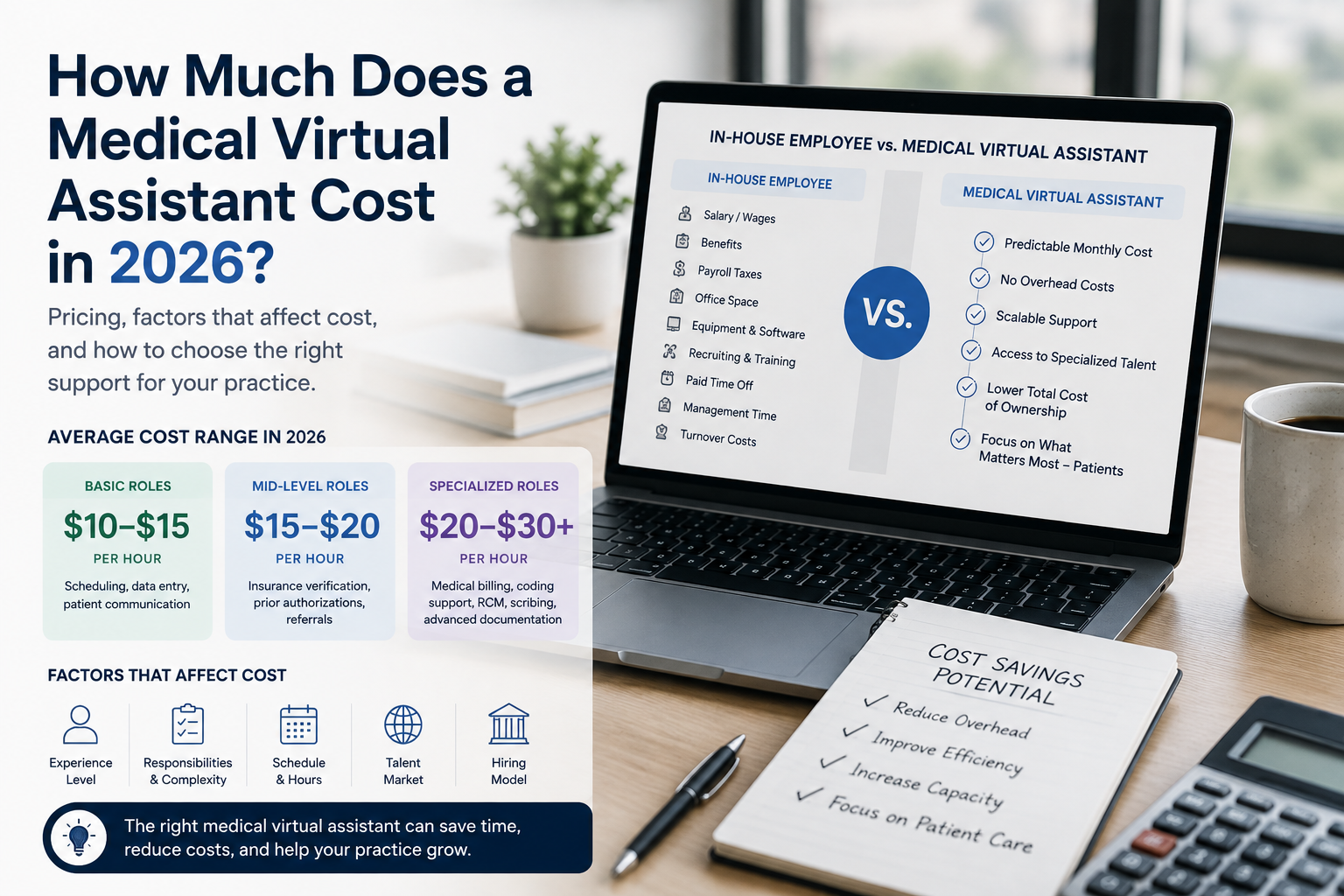
The cost of hiring a medical virtual assistant in 2026 can vary significantly depending on experience, responsibilities, schedule, location, and the type of hiring arrangement you choose.
Some healthcare practices hire independent virtual assistants directly. Others work with specialized staffing companies that handle recruiting, screening, onboarding, training, payroll, and ongoing support.
As a general starting point, medical virtual assistant services may range from approximately $10 to $30 or more per hour, depending on the role and service model. Specialized positions involving medical billing, coding, prior authorizations, or advanced healthcare administration may cost more than general scheduling or front desk support.
The lowest hourly rate is not always the lowest overall cost, however. Practices should also consider recruiting time, training, turnover, compliance procedures, management requirements, technology, and the cost of replacing an unsuccessful hire.
This guide explains the most common pricing models, what influences medical virtual assistant costs, and how to evaluate the true value of remote healthcare support.
A medical virtual assistant may cost approximately $10 to $30 or more per hour in 2026, depending on experience, responsibilities, schedule, location, and whether the assistant is hired independently or through a staffing provider.
Dedicated full-time support may be offered through a monthly service plan, while part-time and specialized roles may be priced differently. Healthcare practices should compare more than the advertised hourly rate and evaluate recruiting, screening, onboarding, payroll, compliance support, management, and replacement policies.
There is no universal rate for medical virtual assistant services.
Pricing typically depends on several factors.
An entry-level assistant who handles basic scheduling and administrative work will generally cost less than someone with several years of healthcare experience.
More experienced medical virtual assistants may already understand:
Their higher rate may be offset by faster onboarding, greater independence, and less day-to-day supervision.
The complexity of the role is one of the biggest pricing factors.
A virtual receptionist who answers calls and schedules appointments may be priced differently from a specialist responsible for:
The more specialized the work, the more important relevant experience becomes.
Pricing can also vary based on whether the practice needs:
A predictable, full-time schedule may be priced through a monthly service plan, while limited or irregular hours may have a different effective rate.
Medical virtual assistants may be located in the United States or in international talent markets.
Remote staffing providers often recruit from countries with strong English proficiency, healthcare experience, and established business process outsourcing industries.
Labor costs differ by region, but geography should not be the only consideration. Communication skills, reliability, healthcare experience, technical ability, and long-term fit are equally important.
How you hire can significantly affect the total cost.
The three most common models are:
Each option offers different levels of cost, control, support, and responsibility.
Under an hourly model, the practice pays based on the number of hours worked.
This model may work well for:
The challenge is that hourly pricing may make monthly costs less predictable when workloads fluctuate.
Many dedicated medical virtual assistant services use a flat monthly rate based on schedule and role.
For example, a practice may pay a set monthly amount for a dedicated part-time or full-time assistant.
Monthly pricing can make budgeting easier and is often well suited for practices that need consistent, ongoing support.
Winning Assistants offers healthcare virtual assistant services starting at approximately $10 per hour, with actual pricing depending on the role, experience, schedule, and scope of work.
Some virtual assistants charge a flat fee for a defined project.
Examples may include:
Project-based pricing can work well when the scope, timeline, and deliverables are clearly defined.
A specialized staffing provider may charge more than hiring an assistant directly because the service can include additional support such as:
The rate should be evaluated based on the full service being provided, not only the assistant’s hourly compensation.
The responsibilities assigned to the assistant can affect pricing.
A virtual medical receptionist may handle:
This is often one of the more accessible entry points for practices hiring remote support.
An insurance verification specialist may be responsible for:
Because this role requires familiarity with insurance portals and payer workflows, relevant experience may affect the rate.
A prior authorization specialist may assist with:
Pricing may vary based on specialty, procedure complexity, and the assistant’s prior experience.
Medical billing support may include:
Experienced medical billers may command higher rates because their work can directly affect the practice’s revenue cycle.
A remote medical scribe may support:
The rate may depend on clinical terminology knowledge, specialty experience, turnaround expectations, and whether support is live or asynchronous.
An in-house employee’s cost extends beyond hourly wages or salary.
Healthcare practices may also incur expenses related to:
A medical virtual assistant may allow a practice to reduce some of these costs because the role is performed remotely.
That does not mean every virtual staffing arrangement is automatically cheaper. The actual savings depend on the service model, the assistant’s productivity, the responsibilities delegated, and how effectively the practice manages the role.
The more useful question is not simply, “Which option has the lowest hourly rate?”
It is:
Which option gives our practice the right level of experience, reliability, support, and productivity at a sustainable total cost?
A low rate can be attractive, but price alone does not determine value.
A poorly matched assistant may create additional costs through:
A more experienced assistant or a more comprehensive staffing service may cost more initially but require less supervision and provide greater consistency.
Practices should evaluate the likely total cost of ownership rather than selecting solely based on the lowest advertised rate.
Hiring directly gives the practice more control over recruiting and compensation, but it also places more responsibility on the internal team.
The practice may be responsible for:
This approach may reduce the visible hourly cost but requires more time and internal resources.
A staffing partner may handle much of the recruiting and administrative process.
Depending on the provider, services may include:
The monthly rate may be higher than hiring independently, but the practice may save time and reduce the operational burden of building a remote team.
To evaluate whether a medical virtual assistant is financially worthwhile, consider three areas.
Estimate how many hours providers and in-office staff spend each week on tasks that could be delegated.
For example:
Then consider what those team members could accomplish if that time were redirected toward higher-value responsibilities.
Compare the remote staffing cost with the full cost of an in-house hire.
Include more than salary.
Factor in:
Consider whether additional support could help your practice:
These outcomes should not be assumed or guaranteed, but they can help determine whether the role has the potential to create meaningful operational value.
Before choosing a medical virtual assistant provider, ask:
Clear answers make it easier to compare providers fairly.
A medical virtual assistant may be worth the cost when the practice has consistent administrative work that can be delegated safely and effectively.
Common indicators include:
The best results generally come from assigning clear responsibilities, providing access to documented processes, setting expectations, and communicating regularly.
Medical virtual assistant rates may range from approximately $10 to $30 or more per hour, depending on the assistant’s experience, responsibilities, location, schedule, and hiring model.
A staffing company may include recruiting, screening, background checks, onboarding, payroll, account support, and replacement assistance in its pricing. Hiring directly may have a lower visible rate but requires the practice to manage these responsibilities internally.
They can be. Roles involving medical billing, coding, prior authorizations, insurance verification, revenue cycle management, or advanced documentation may require more experience and therefore carry a higher rate.
Hourly pricing may work well for limited or variable needs. Monthly pricing is often better for practices that require consistent, dedicated support and want predictable costs.
Many solo providers and small practices begin with part-time support. The appropriate schedule depends on workload, budget, and the tasks being delegated.
Not necessarily. Practices should consider experience, reliability, training, support, turnover, security procedures, and the amount of management required in addition to the advertised rate.
The cost of a medical virtual assistant in 2026 depends on far more than an hourly number.
Experience, specialization, schedule, hiring model, recruiting support, management, and replacement policies all influence the true cost of the service.
For some practices, hiring independently may be appropriate. Others may prefer the structure and support of a healthcare-focused staffing partner.
The best choice is the one that provides the right combination of experience, reliability, operational support, and sustainable value for your practice.
Winning Assistants helps healthcare practices connect with experienced remote professionals for roles such as patient scheduling, insurance verification, prior authorization support, medical billing, documentation, and front office administration.
Explore our medical virtual assistant pricing, review the roles we help fill, or see how other healthcare organizations have used remote support in our client testimonials and case studies.
When you are ready to discuss your practice’s needs, book a consultation to explore the role, schedule, and level of experience that may be the best fit.