August 7, 2026
Healthcare Staffing: The Complete Guide for Modern Medical Practices
.png)
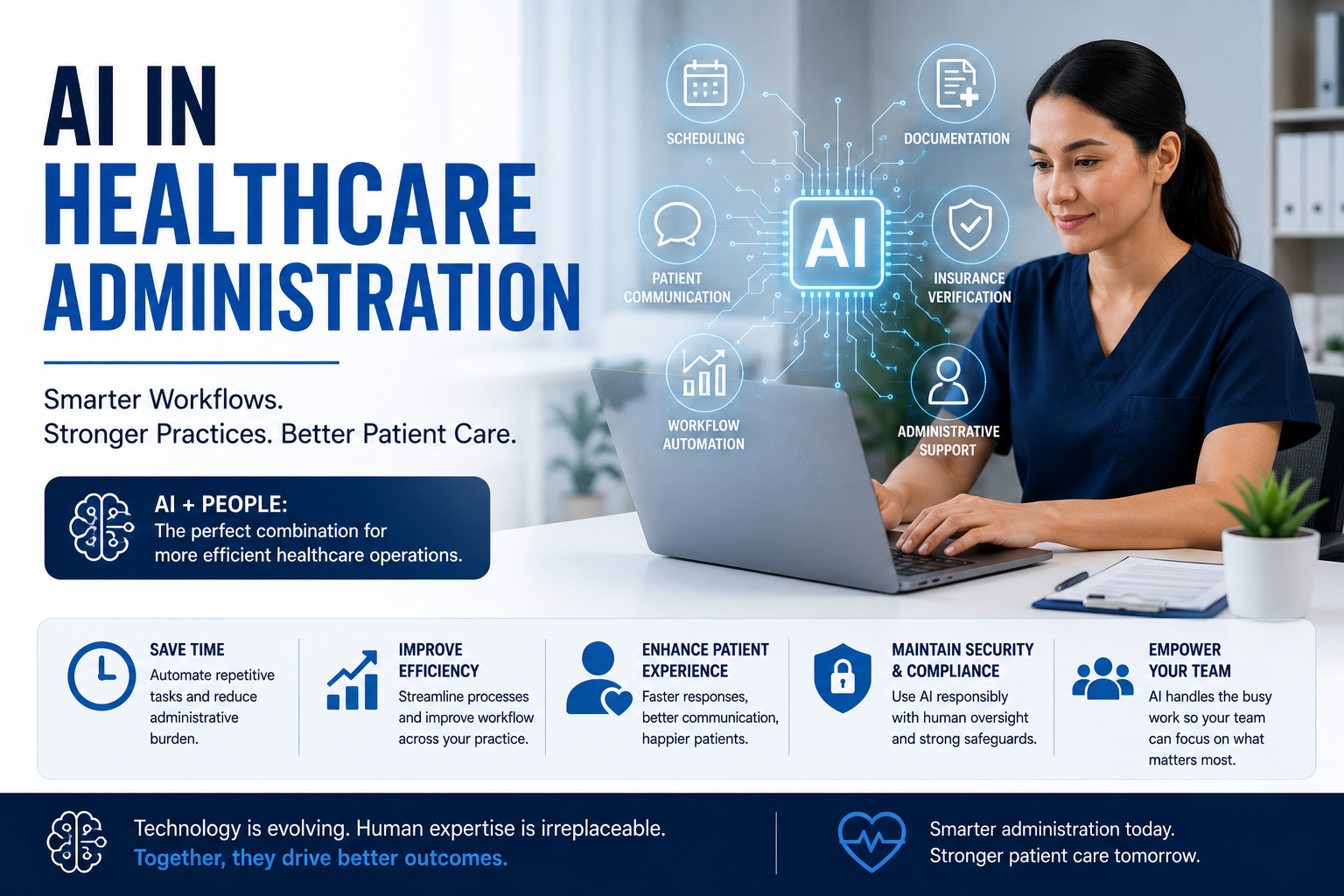
Artificial intelligence has become one of the biggest topics in healthcare.
From documentation tools to scheduling assistants and workflow automation, healthcare organizations are exploring how AI can help reduce administrative workload and improve operational efficiency.
While AI continues to evolve rapidly, it’s important to understand both its strengths and its limitations.
The most successful healthcare practices aren’t replacing people with AI—they’re using AI to help their teams work more efficiently.
AI can help healthcare practices automate repetitive administrative tasks, organize information, assist with documentation, improve scheduling, and streamline workflows. However, human oversight remains essential for patient communication, critical decision-making, problem solving, and delivering a high-quality patient experience.
Healthcare teams spend a significant portion of each day on administrative work.
Tasks such as scheduling appointments, responding to routine inquiries, documenting information, verifying insurance, organizing records, and managing workflows can consume valuable time.
AI has the potential to reduce some of this workload by assisting with repetitive and time-consuming processes.
Rather than replacing healthcare teams, AI often serves as a productivity tool that helps staff focus on higher-value responsibilities.
Healthcare organizations are already using AI in a variety of administrative workflows.
Examples include:
These tools continue to improve as technology advances.
Despite impressive advances, AI cannot replace every aspect of healthcare administration.
Many responsibilities require judgment, empathy, communication, and critical thinking.
These include:
Healthcare remains a people-first industry.
Technology should support people—not replace them.
One of the most effective operational models combines AI with experienced virtual healthcare assistants.
For example:
AI may help organize documentation, summarize information, or automate repetitive administrative tasks.
Meanwhile, a virtual healthcare assistant can:
Together, they create a more efficient administrative team.
When implemented thoughtfully, AI may help practices:
The greatest benefits often come when AI is integrated into well-designed workflows rather than used as a standalone solution.
As healthcare organizations adopt AI, they should also evaluate:
AI should always be implemented thoughtfully and in accordance with applicable laws, regulations, and organizational policies.
Not likely.
AI is well suited for assisting with repetitive tasks, but many healthcare workflows still require communication, judgment, empathy, and human decision-making.
In many cases, AI actually makes virtual healthcare assistants more productive.
By automating routine work, assistants can spend more time supporting patients, providers, and practice operations.
Healthcare operations involve countless situations that require experience, flexibility, and interpersonal communication.
AI is a tool—not a replacement for an experienced administrative team.
AI may assist with answering routine administrative questions, but many patient interactions still require human review and judgment, particularly when situations become more complex.
AI can support certain billing workflows, but experienced administrative professionals remain essential for managing denials, payer communication, follow-up, and resolving complex billing issues.
AI can be used responsibly when organizations implement appropriate privacy, security, oversight, and governance practices while complying with applicable healthcare regulations.
The ability to reduce repetitive administrative work, allowing healthcare teams to focus more on patient care and higher-value responsibilities.
Artificial intelligence is changing healthcare administration, but its greatest value comes from supporting—not replacing—people.
The practices seeing the strongest results are combining AI with experienced administrative professionals to create faster, more efficient workflows while maintaining the human connection patients expect.
As technology continues to evolve, organizations that thoughtfully integrate AI into their operations will be well positioned to improve efficiency without losing sight of what matters most: delivering exceptional patient care.
At Winning Assistants, we believe the future of healthcare combines intelligent technology with exceptional people.
Our experienced virtual healthcare assistants work alongside the tools your practice already uses to support scheduling, patient communication, insurance verification, prior authorizations, medical billing support, documentation, medical scribing, and many other non-clinical healthcare workflows.
If you’re looking to build a more efficient healthcare practice, book a free consultation to learn how virtual healthcare assistants and modern technology can work together to support your growth.