August 7, 2026
Healthcare Staffing: The Complete Guide for Modern Medical Practices
.png)
Healthcare staffing continues to evolve rapidly.
Practice owners are navigating rising operational costs, changing patient expectations, workforce shortages, new technology, and increasing administrative demands—all while striving to deliver exceptional patient care.
As a result, many healthcare organizations are rethinking how they build and manage their teams.
Here are some of the biggest staffing trends shaping healthcare in 2026.
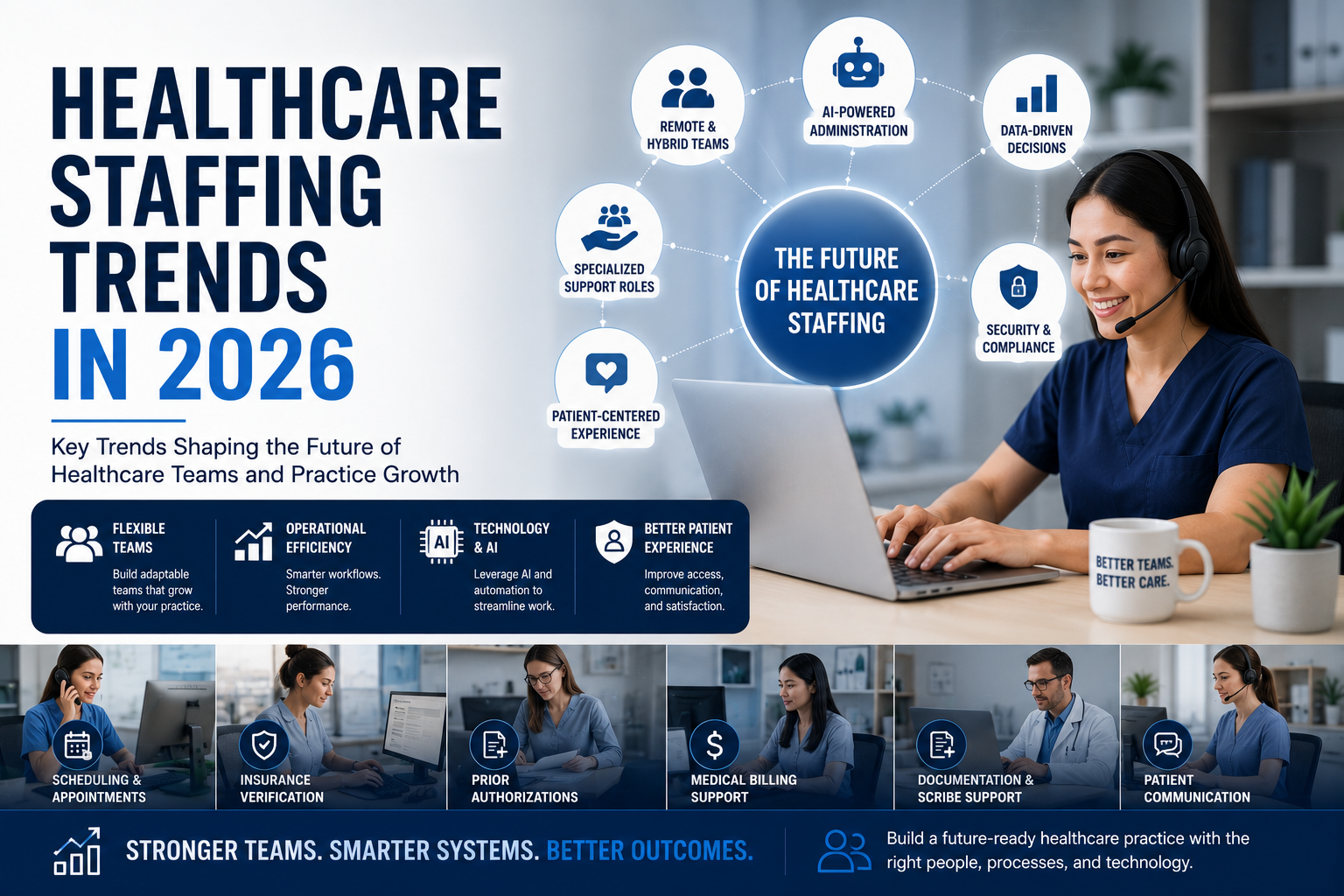
Healthcare staffing in 2026 is increasingly focused on flexibility, operational efficiency, technology adoption, and building teams that combine in-office employees, virtual healthcare assistants, and AI-powered tools to better support providers and patients.
One of the most noticeable trends is the continued growth of remote administrative support.
Many healthcare practices are expanding their teams with virtual healthcare assistants who help manage non-clinical responsibilities such as:
This allows providers and in-office staff to focus more of their attention on patient care.
Hiring more people isn’t always the answer.
Many practices are instead looking for ways to improve existing workflows.
Common areas of focus include:
Practices with efficient operations are often better positioned for sustainable growth.
Artificial intelligence continues to become more common across healthcare administration.
Organizations are using AI to assist with:
Rather than replacing administrative teams, AI is increasingly being used to help them work more efficiently.
Healthcare organizations increasingly want staffing solutions that can adapt as patient demand changes.
Whether adding a provider, opening a new location, or launching a new service line, practices are looking for staffing models that allow them to expand administrative capacity without unnecessary complexity.
Flexible staffing has become an important part of long-term growth planning.
Healthcare is becoming increasingly consumer-focused.
Patients expect:
Administrative teams play a major role in delivering these experiences.
Practices are investing in staffing strategies that improve responsiveness without sacrificing quality.
Rather than asking one employee to handle everything, many organizations are creating more specialized positions.
Examples include:
Specialization often leads to greater consistency and efficiency.
Staffing decisions are increasingly guided by operational metrics.
Practice leaders are monitoring:
These insights help organizations make more informed staffing decisions.
As remote work continues to grow, healthcare organizations remain focused on protecting patient information.
Many practices are strengthening:
Security remains an essential part of every staffing strategy.
Modern healthcare operations increasingly combine:
The goal is to build systems where every team member focuses on the work they perform best.
Perhaps the biggest trend is a shift in mindset.
Healthcare organizations are no longer focused solely on hiring more people.
Instead, they’re building scalable systems that allow them to grow efficiently while maintaining excellent patient care.
That includes:
Growth today is about building a stronger organization—not simply a larger one.
Healthcare is changing quickly.
Practices that embrace efficient workflows, flexible staffing models, thoughtful technology adoption, and strong administrative systems are often better positioned to navigate future growth.
The objective isn’t simply to keep up with change.
It’s to build an organization that’s prepared for it.
Yes. Many healthcare organizations are expanding their administrative teams with remote professionals who support scheduling, insurance verification, patient communication, billing support, documentation, and other non-clinical responsibilities.
AI is helping automate certain administrative tasks, but human communication, judgment, and patient relationships remain essential throughout healthcare operations.
Many practices are focusing on operational flexibility by combining in-office employees, virtual healthcare assistants, and technology to create more efficient administrative teams.
Even small practices can improve efficiency by reviewing workflows, standardizing processes, adopting helpful technology, and strategically delegating administrative work.
Healthcare staffing in 2026 is about much more than filling open positions.
It’s about building resilient, efficient teams that can support exceptional patient care while adapting to an increasingly complex healthcare environment.
Practices that invest in strong operational systems, embrace technology thoughtfully, and build flexible administrative teams will be well positioned for sustainable growth in the years ahead.
At Winning Assistants, we help healthcare practices build modern administrative teams by providing experienced virtual healthcare assistants who support scheduling, patient communication, insurance verification, prior authorizations, medical billing support, documentation, medical scribing, and many other non-clinical healthcare workflows.
Whether you’re looking to improve efficiency, reduce administrative burden, or prepare your practice for future growth, book a free consultation to learn how virtual healthcare assistants can become an extension of your team.