

August 7, 2026
Healthcare Staffing: The Complete Guide for Modern Medical Practices
.png)
Healthcare providers often spend far more time on administrative work than they would like.
Between answering phone calls, scheduling appointments, verifying insurance, documenting patient information, and managing endless administrative tasks, valuable time is pulled away from patient care.
That’s why many healthcare practices are turning to medical virtual assistants.
Medical virtual assistants can help manage many of the day-to-day administrative responsibilities that keep a practice running smoothly. By delegating repetitive operational work, providers and in-office staff can focus on delivering exceptional care while improving efficiency across the practice.
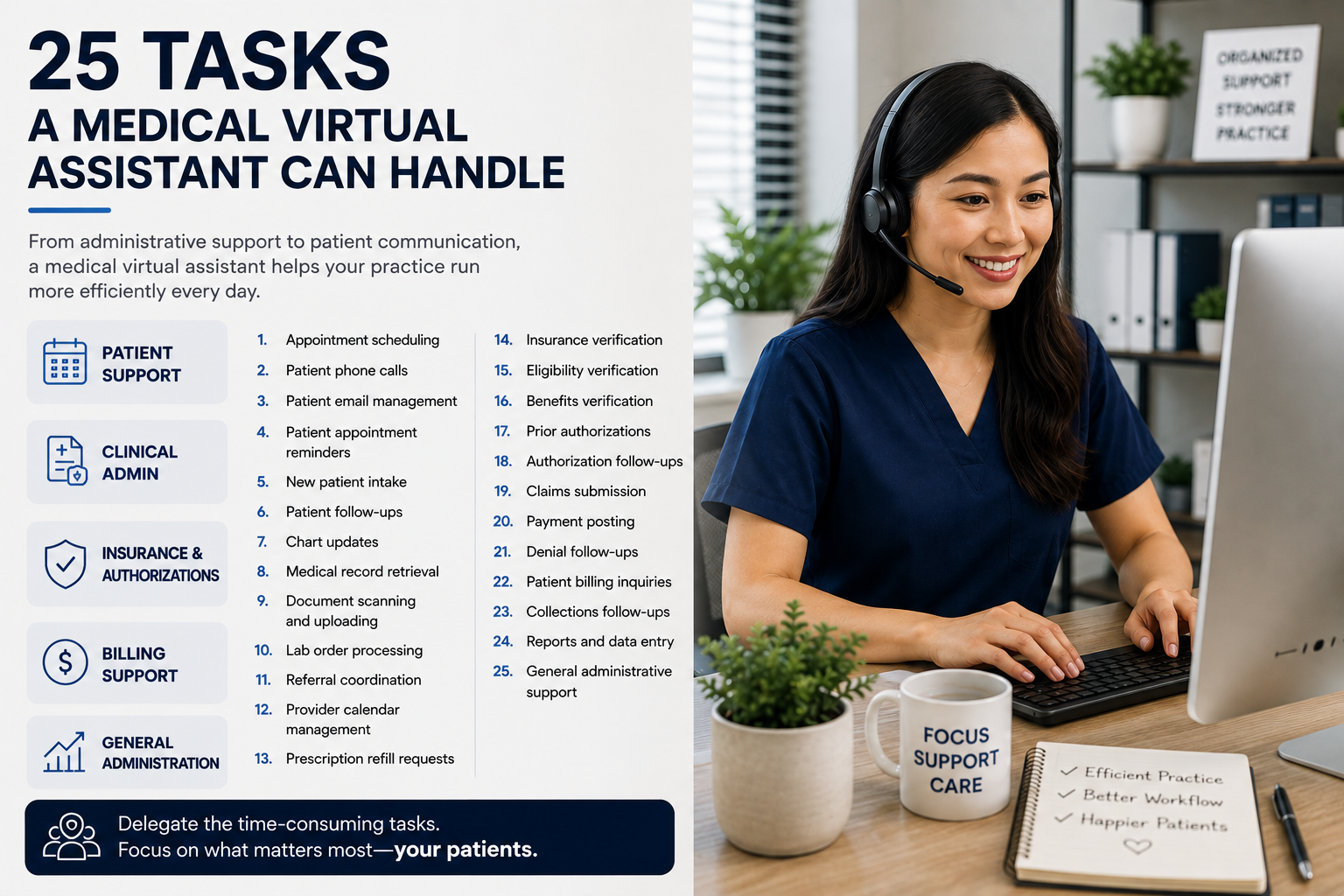
If you’re wondering what a medical virtual assistant can actually do, here are 25 of the most common responsibilities they can support.
Medical virtual assistants can assist with a wide variety of non-clinical administrative responsibilities, including scheduling appointments, answering patient calls, insurance verification, prior authorizations, documentation support, medical billing, referral coordination, and many other daily operational tasks.
The exact responsibilities depend on your practice’s workflow, specialty, and operational needs.
Coordinate new patient appointments, follow-up visits, and provider calendars while helping reduce scheduling conflicts.
Handle inbound calls, answer routine questions, take messages, and route patients to the appropriate team member when necessary.
Contact patients by phone, text, or email to remind them of upcoming appointments and reduce missed visits.
Follow up with patients after appointments, missed visits, or provider requests while maintaining consistent communication.
Organize patient emails, respond to routine inquiries, and help maintain an organized inbox.
Coordinate provider schedules, meetings, vacations, and administrative calendars.
Confirm patient insurance eligibility before appointments to help reduce billing issues.
Verify coverage details, deductibles, copays, and other patient benefit information.
Prepare documentation, submit authorization requests, and monitor approval status.
Manage incoming and outgoing referrals while ensuring required documentation is complete.
Collect and organize patient demographic information before appointments.
Maintain accurate administrative records across practice management systems and electronic health records.
Assist with entering charges accurately into billing systems according to established workflows.
Prepare claims for submission and assist with administrative billing workflows.
Record payments received from insurance companies and patients.
Monitor outstanding balances and assist with claims follow up as directed.
Help organize denied claims and assist with administrative follow-up to support the revenue cycle.
Update patient information and maintain organized electronic health records according to your practice’s procedures.
Prepare patient charts before appointments so providers have the information they need.
Convert provider dictation into organized written documentation.
Assist with organizing documentation into SOAP note format when appropriate.
Review documentation for completeness and identify missing administrative information before provider review.
Prepare spreadsheets, reports, and operational summaries that help practice leaders monitor daily performance.
Assist with organizing administrative workflows, documenting procedures, and improving day-to-day operational efficiency.
Support your practice wherever additional administrative capacity is needed, allowing your in-office team to focus on higher-value responsibilities.
Not necessarily.
Every medical virtual assistant has a unique background, level of experience, and area of expertise.
Some specialize in front office administration, while others focus on insurance verification, medical billing, documentation, or revenue cycle support.
The responsibilities assigned should match the assistant’s experience as well as your practice’s operational needs.
Although medical virtual assistants can support many administrative responsibilities, certain duties generally remain with on-site clinical staff.
These typically include:
Medical virtual assistants are intended to complement your healthcare team, not replace licensed providers or clinical staff.
A good starting point is identifying the responsibilities that consume the most time each week.
Ask yourself:
The answers often reveal where a medical virtual assistant can provide the greatest operational value.
Yes. Many practices use medical virtual assistants to manage incoming calls, schedule appointments, and respond to routine patient inquiries according to established procedures.
Yes. Depending on their experience and assigned responsibilities, many medical virtual assistants provide administrative billing support, payment posting, claims follow up, and other revenue cycle functions.
Often, yes. Many medical virtual assistants support scheduling, insurance verification, patient communication, documentation, and administrative coordination within the same position.
Absolutely. A dermatology practice, orthopedic clinic, mental health provider, or primary care office may each delegate different administrative responsibilities based on their workflows.
Start with the administrative tasks that consume the most provider or staff time. Scheduling, insurance verification, patient communication, and documentation are often excellent starting points.
Medical virtual assistants can support far more than answering phones or scheduling appointments.
They can become an extension of your administrative team, helping manage insurance verification, documentation, patient communication, billing support, referrals, and many other operational responsibilities that keep a healthcare practice running efficiently.
Every practice is different, but identifying the right responsibilities to delegate can free up valuable time, improve workflows, and allow providers to focus more on delivering exceptional patient care.
If you’re considering adding a medical virtual assistant to your practice, we’re here to help.
At Winning Assistants, we connect healthcare practices with experienced medical virtual assistants who can support a wide range of administrative responsibilities tailored to your workflow and operational needs.
Book a free consultation to discuss your practice and explore which responsibilities could be delegated to help your team operate more efficiently.