
August 7, 2026
Healthcare Staffing: The Complete Guide for Modern Medical Practices
.png)
Every healthcare practice reaches a point where administrative responsibilities begin competing with patient care.
Phone calls become harder to keep up with.
Insurance verification starts falling behind.
Providers spend more evenings catching up on documentation.
Patients wait longer for responses.
While these challenges are common, they often signal that your practice has outgrown its current administrative capacity.
A medical virtual assistant can help relieve many of these operational pressures by supporting non-clinical administrative responsibilities, allowing providers and in-office staff to focus on delivering exceptional patient care.
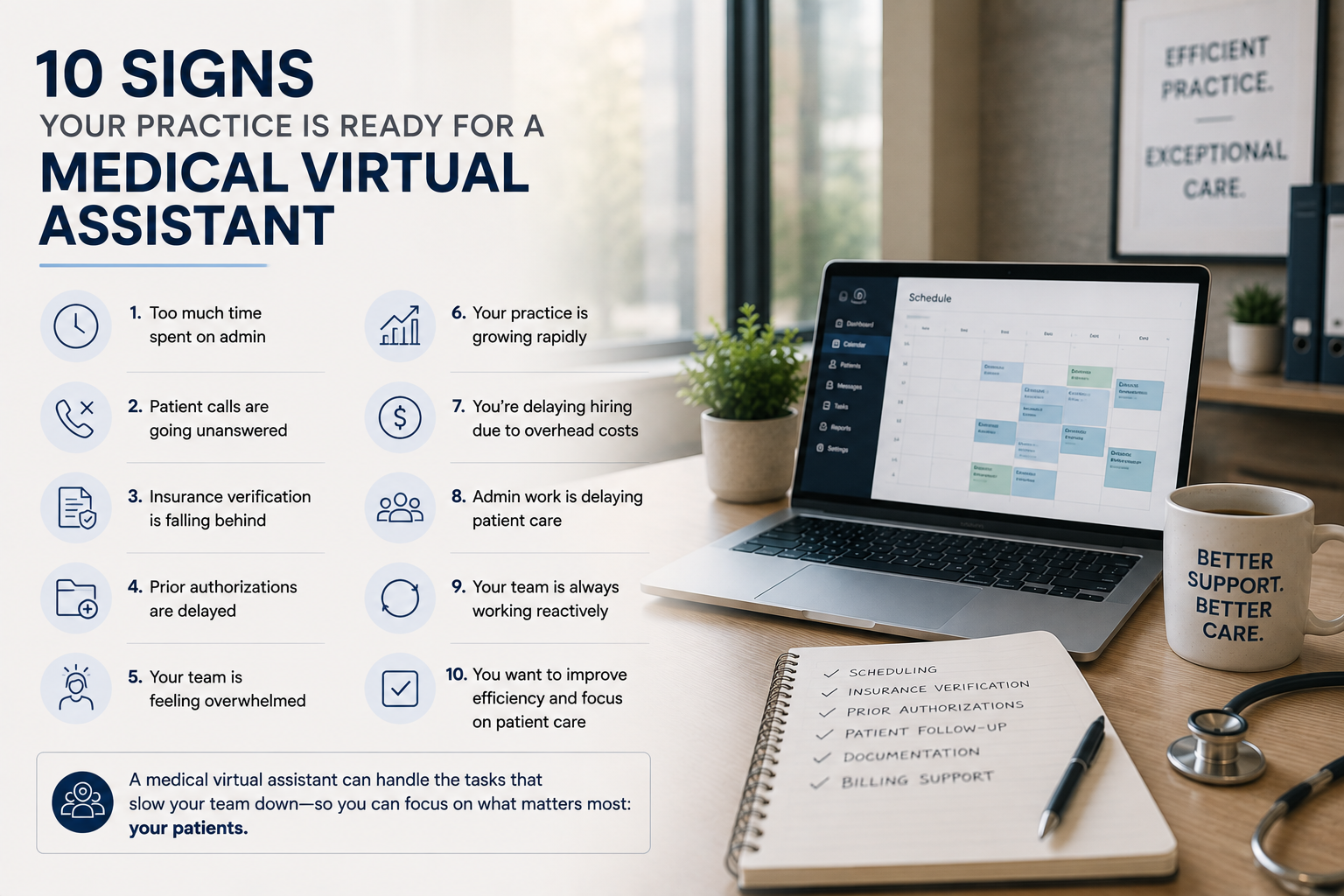
Here are ten common signs that it may be time to consider adding a medical virtual assistant to your team.
Your practice may be ready for a medical virtual assistant if administrative work is slowing your team down, patient communication is becoming difficult to manage, scheduling bottlenecks are increasing, insurance verification is falling behind, or providers are spending too much time on non-clinical responsibilities.
Healthcare providers are trained to care for patients—not spend hours managing calendars, answering emails, completing paperwork, or following up on administrative tasks.
If providers regularly stay late catching up on non-clinical work, additional administrative support may be worth considering.
A busy front desk often becomes the center of every interruption.
Phone calls, patient check-ins, scheduling requests, insurance questions, and provider messages all compete for attention.
When the front desk is consistently overwhelmed, service quality can suffer.
Every missed phone call represents a patient who couldn’t reach your office.
Over time, unanswered calls may lead to scheduling delays, frustrated patients, and missed opportunities to serve your community.
Additional administrative support can help practices respond more consistently throughout the day.
Insurance verification is essential before many appointments, but it also requires significant administrative time.
If eligibility checks are being rushed or delayed, it may create unnecessary problems for both patients and staff.
Prior authorizations often require documentation, payer communication, follow-up, and careful organization.
If authorizations are consistently delayed or consuming a large portion of your team’s day, additional administrative support may help improve workflow.
Administrative overload affects more than productivity.
When employees constantly feel overwhelmed, it can contribute to stress, frustration, and reduced job satisfaction.
Creating additional administrative capacity may help distribute workloads more effectively.
Growth is exciting—but it also creates new operational demands.
As patient volume increases, so do phone calls, scheduling requests, documentation, billing activities, and administrative coordination.
Supporting growth often requires expanding administrative capacity alongside clinical services.
Many healthcare practices know they need additional support but hesitate because of the costs associated with hiring another in-house employee.
Exploring remote administrative staffing may provide another option worth evaluating depending on your practice’s needs and staffing strategy.
Providers and clinical staff frequently depend on administrative work being completed efficiently.
Scheduling delays, incomplete documentation, insurance issues, and communication backlogs can all affect daily operations.
Improving administrative workflows often benefits both staff and patients.
One of the clearest signs that a practice needs additional support is when every day feels like catching up.
Instead of proactively managing schedules and patient communication, your team spends most of the day responding to problems as they arise.
Additional administrative support can help practices become more organized and proactive over time.
Depending on your practice’s needs, a medical virtual assistant may assist with responsibilities such as:
Every practice is different, so responsibilities should be tailored to your workflow and operational goals.
Many healthcare providers wait until they feel completely overwhelmed before seeking additional support.
In many cases, hiring before administrative bottlenecks become severe can make onboarding smoother and allow new team members to integrate into existing workflows gradually.
There is no universal “right” time to hire, but recognizing operational challenges early allows practices to make more proactive staffing decisions.
If providers or staff are consistently spending excessive time on administrative work, patient communication is becoming difficult to manage, or operational bottlenecks are affecting daily workflows, it may be worth evaluating additional administrative support.
Yes. Many solo providers and smaller healthcare practices use medical virtual assistants to increase administrative capacity without significantly expanding in-office staffing.
Typically, no.
Medical virtual assistants are often used to support existing staff by taking ownership of administrative responsibilities, allowing the rest of the team to focus on higher-value work.
Scheduling, patient communication, insurance verification, documentation support, and administrative follow-up are common starting points.
Every healthcare practice experiences busy seasons and operational challenges.
The key is recognizing when administrative responsibilities begin limiting your team’s ability to deliver excellent patient care.
If several of the signs in this article sound familiar, it may be worth exploring whether additional administrative support could improve your workflows, reduce administrative burden, and create more capacity for your team.
The goal isn’t simply to hire another person—it’s to build a more efficient practice that allows providers and staff to focus on what they do best.
Every practice has unique staffing needs, workflows, and goals.
If you’re wondering whether a medical virtual assistant could help improve your operations, book a free consultation with Winning Assistants. We’ll learn about your practice, discuss your current administrative challenges, and help you determine whether remote administrative support is the right fit for your team.